
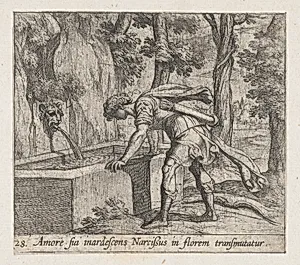
Plate 28: Narcissus at the Well (Amore fui inardescens Narcißus in florem transmutatur), from Ovid's 'Metamorphoses'
1606
Medium
Etching
Dimensions
Sheet: 4 1/8 × 4 5/8 in. (10.5 × 11.7 cm)
Classification
Prints
Department
Drawings and Prints
Museum
Metropolitan Museum of Art, New York, NY
Credit
The Elisha Whittelsey Collection, The Elisha Whittelsey Fund, 1951
Accession Number
51.501.3879
Rights
Public Domain
Tags
Art Historical Context
This etching by Antonio Tempesta, created in 1606, illustrates Plate 28 from a series depicting scenes in Ovid’s Metamorphoses. It portrays the mythological youth Narcissus at a well, transfixed by his own reflection before transforming into a flower—the Latin inscription emphasizes his burning self-love and ultimate change. The compact sheet, measuring roughly four by five inches, distills a timeless tale of desire and metamorphosis into a single, evocative image. Tempesta, an Italian printmaker active during the late Renaissance and early Baroque eras, specialized in such narrative series that brought classical literature to wider audiences through affordable prints. Etching allowed him to achieve fine linear detail and dramatic contrasts, making the emotional intensity of the myth accessible even in this small format. Now part of the Metropolitan Museum’s Drawings and Prints collection, the work reflects how 17th-century artists reinterpreted ancient stories to explore human nature, preserving Ovid’s themes for new generations of viewers.
About the Artist
Antonio Tempesta · 1555–1630
Antonio Tempesta (1555–1630), known as 'Il Tempestino,' was a Florentine painter and printmaker whose extraordinary output of approximately 1,700 etchings made him one of the most influential printmakers of the early Baroque period. Born in Florence and trained under Santi di Tito and the Flemish master Joannes Stradanus, he enrolled in the Accademia del Disegno in 1576 before relocating to Rome i...