
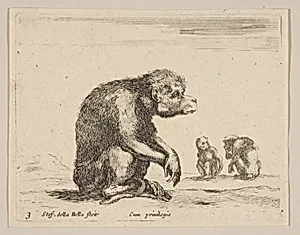
Plate 3: seated monkey, from "Various animals" (Diversi animali)
Medium
Etching; third state of three (De Vesme)
Dimensions
Plate: 3 3/16 × 4 1/8 in. (8.1 × 10.4 cm) Sheet: 3 3/8 × 4 5/16 in. (8.5 × 11 cm)
Classification
Prints
Department
Drawings and Prints
Museum
Metropolitan Museum of Art, New York, NY
Credit
Bequest of Grace M. Pugh, 1985
Accession Number
1986.1180.589
Rights
Public Domain
Tags
Art Historical Context
Behold the charming *Plate 3: Seated Monkey* from Stefano della Bella's series *Various Animals (Diversi animali)*, around 1641. This intimate print, now in its third and final state as catalogued by De Vesme, captures a monkey in a relaxed, contemplative pose, exemplifying Bella's mastery as a 17th-century Florentine. Working in the Baroque era, he was renowned for his lively depictions of animals, blending scientific observation with whimsical expressiveness in a series that explored the diversity of the natural world. Crafted as an etching—a technique della Bella perfected for its precise, fluid lines—this small plate (just 3 3/16 × 4 1/8 inches) reveals intricate fur textures and subtle shading that bring the monkey to life. Etchings like this were prized for their reproducibility, allowing collectors across Europe to enjoy della Bella's skill. Printed later by Pierre François Basan, it reflects the enduring appeal of these animal studies, which served both as artistic virtuosity and aids for natural history enthusiasts. Today, this gem resides in the Metropolitan Museum of Art's Drawings and Prints department, thanks to the bequest of Grace M. Pugh in 1985. Notice the monkey's alert gaze— a delightful nod to curiosity in Baroque art!
About the Artist
Stefano della Bella|Pierre François Basan · 1610–1664
Stefano della Bella (1610-1664) was one of the most prolific and versatile printmakers of the Italian Baroque period, leaving behind 1,052 prints and several thousand drawings that captured the vivid essence of 17th-century European life. Born in Florence on May 18, 1610, to a family of artists, he trained initially as a goldsmith before studying painting under Cesare Dandini and etching under Rem...