
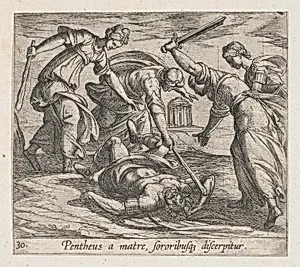
Plate 30: The Death of Pentheus (Pentheus a matre, sororibusq discerpitur), from Ovid's 'Metamorphoses'
1606
Medium
Etching
Dimensions
Sheet: 4 1/8 × 4 5/8 in. (10.4 × 11.7 cm)
Classification
Prints
Department
Drawings and Prints
Museum
Metropolitan Museum of Art, New York, NY
Credit
The Elisha Whittelsey Collection, The Elisha Whittelsey Fund, 1951
Accession Number
51.501.3881
Rights
Public Domain
Tags
Art Historical Context
Behold Plate 30 from Antonio Tempesta's masterful series of etchings illustrating Ovid's *Metamorph*, published in 1606. This vivid scene captures the gruesome death of Pentheus, ill-fated king of Thebes from the Roman poet's epic. In a frenzy induced by Dionysus, the god of wine, Pentheus torn limb from limb by his own mother, Agave, and her sisters— a stark warning against hubris and denial of divine ecstasy. Tempesta's dynamic composition teems with writhing figures, emphasizing the chaos of the Bacchic rite. As a leading Italian etcher of the early Baroque period, Tempesta excelled in translating classical myths into intricate prints, making ancient stories accessible to a wide audience during the Renaissance revival of antiquity. Etching, with its fine lines etched into a metal plate and inked for reproduction, allowed for the subtle textures of flesh, fabric, and frenzy in this compact 4 1/8 × 4 5/8 in. sheet. His style blends Mannerist elegance with emerging Baroque drama, showcasing men and women in raw, emotional turmoil. Housed in the Metropolitan Museum of Art's Drawings and Prints department, thanks to The Elisha Whittelsey Collection, this print highlights the enduring cultural fascination with Ovid's tales. It invites visitors to ponder the thin line between civilization and primal madness, a theme resonant from ancient Rome to the grand tours of 17th-century Europe.
About the Artist
Antonio Tempesta · 1555–1630
Antonio Tempesta (1555–1630), known as 'Il Tempestino,' was a Florentine painter and printmaker whose extraordinary output of approximately 1,700 etchings made him one of the most influential printmakers of the early Baroque period. Born in Florence and trained under Santi di Tito and the Flemish master Joannes Stradanus, he enrolled in the Accademia del Disegno in 1576 before relocating to Rome i...