
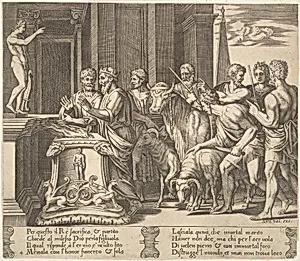
Plate 4: Psyche's father consulting the oracle, from "The Fable of Psyche"
Medium
Engraving
Dimensions
sheet: 7 11/16 x 8 7/8 in. (19.5 x 22.5 cm)
Classification
Prints
Department
Drawings and Prints
Museum
Metropolitan Museum of Art, New York, NY
Credit
Gift of Harry G. Friedman, 1962
Accession Number
62.635.907
Rights
Public Domain
Tags
Art Historical Context
This engraving, created between 1530 and 1560, forms part of a narrative series illustrating the ancient Roman tale of Psyche from Apuleius’s *The Golden Ass*. The scene captures Psyche’s father seeking guidance from an oracle, surrounded by sacrificial animals including bulls and rams. Rendered in the precise lines of engraving—a medium prized during the Renaissance for its ability to reproduce fine detail and reach wide audiences—the print measures just under eight by nine inches, making it intimate yet impactful for collectors and scholars alike. The collaboration reflects the era’s printmaking networks: Michiel Coxie likely provided the design, while the Master of the Die executed the engraving and Antonio Salamanca handled publication. Such series helped popularize classical myths across Europe, transforming literary stories into accessible visual experiences that blended moral allegory with decorative appeal. Today housed in the Metropolitan Museum of Art, this work highlights how 16th-century printmakers bridged antiquity and contemporary audiences, inviting viewers to follow Psyche’s transformative journey from mortal trials to divine love.
About the Artist
Master of the Die|Antonio Salamanca|Michiel Coxie (I) · 1525–1560
**Master of the Die** (fl. 1525–1560) was an anonymous Italian engraver and printmaker active primarily in Rome during the mid-16th century. Named for the distinctive small die he used to sign his prints—a tiny emblematic mark that became his moniker—this elusive artist remains unidentified despite scholarly proposals linking him to figures like Benedetto Verino, Giovanni Francesco Zabello, Tommas...