
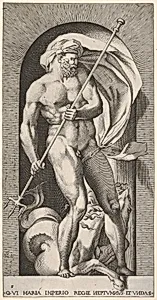
Plate 5: Neptune standing in a niche holding a trident, with a hippocampus (sea-horse) behind him, from a series of gods and goddesses
Medium
Engraving
Dimensions
sheet: 8 3/16 x 4 3/16 in. (20.8 x 10.7 cm)
Classification
Prints
Department
Drawings and Prints
Museum
Metropolitan Museum of Art, New York, NY
Credit
Gift of Harry G. Friedman, 1962
Accession Number
62.635.950
Rights
Public Domain
Tags
Art Historical Context
In the vibrant world of Renaissance printmaking, *Plate 5: Neptune in a niche holding a trident, with a hippocampus (sea-horse) behind him* stands out as a masterful engraving from 1526. Created by Giovanni Jacopo Caraglio after designs by the Mannerist painter Rosso Fiorentino, this work is part of a celebrated series depicting gods and goddesses. Neptune, the Roman god of the sea, commands the composition from within an architectural niche, his trident raised assertively while a mythical hippocampus—a winged sea horse—curls dynamically behind him, evoking the grandeur of classical mythology. Rosso Fiorentino's influence shines through in the elegant, elongated forms and intricate detailing typical of early Mannerism, a style that twisted Renaissance harmony into more expressive, artificial poses. Caraglio's engraving technique—using fine burin lines for texture and depth—captures the shimmering scales of the hippocampus and the god's flowing drapery with remarkable precision on the modest sheet (8 3/16 x 4 3/16 in.). This print's historical significance lies in its role disseminating Mannerist innovations across Europe, blending antique lore with innovative artistry. A gift to the Metropolitan Museum of Art in 1962, it invites visitors to ponder how such affordable engravings brought divine drama into everyday Renaissance life.
About the Artist
Giovanni Jacopo Caraglio|Rosso Fiorentino · 1500–1565
Italian, Parma or Verona ca. 1500/1505–1565 Krakow (?)