
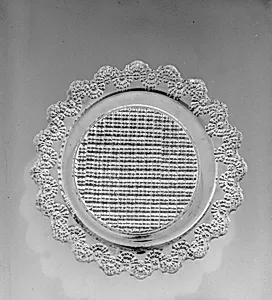
Plate
Unknown Artist
ca. 1830
Medium
Lacy pressed glass
Dimensions
Diam. 5 15/16 in. (15.1 cm)
Classification
Plate
Culture
American
Department
The American Wing
Museum
Metropolitan Museum of Art, New York, NY
Credit
Gift of Mrs. Charles W. Green, in memory of Dr. Charles W. Green, 1951
Accession Number
51.171.90
Rights
Public Domain
Art Historical Context
This delicate Lacy pressed glass plate, crafted around 1830 by an unknown American artist, exemplifies the of early 19th American glassmaking. Measuring just under 6 inches in diameter, its fine, lace-like patterns—created through a revolutionary pressing technique—evoke the elegance of handmade lace textiles while showcasing mass-produced affordability. Housed in The Metropolitan Museum of Art's American Wing, it reflects a pivotal moment when U.S. factories democratized luxury tableware for middle-class homes. The "Lacy" style emerged in the 1820s–1840s, as innovators like Deming Jarves at the Boston & Sandwich Glass Company used intricate metal molds to imprint detailed motifs such as floral swags or gothic arches onto molten glass. This method replaced costly cutting and engraving, making ornate designs accessible and spurring a boom in American decorative arts during the Industrial Revolution. A gift to the Met in 1951 honoring Dr. Charles W. Green, this plate highlights everyday objects as cultural treasures, preserving the optimism and craftsmanship of Jacksonian America. Visitors can appreciate how such pieces bridged folk art and industry, adorning parlors with subtle sophistication.