
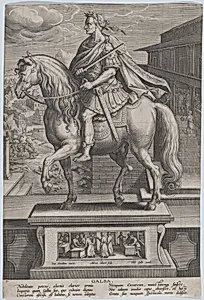
Plate 7: equestrian statue of Galba, in profile to the left, with a beheading scene in the background, from 'Roman Emperors on Horseback'
Medium
Engraving, squared in graphite
Dimensions
Sheet (Trimmed): 12 11/16 × 8 9/16 in. (32.3 × 21.7 cm)
Classification
Prints
Department
Drawings and Prints
Museum
Metropolitan Museum of Art, New York, NY
Credit
The Elisha Whittelsey Collection, The Elisha Whittelsey Fund, 1949
Accession Number
49.95.1002(7)
Rights
Public Domain
Tags
Art Historical Context
This engraving, *Plate 7: e statue of Galba, profile to the left, a beheading scene in background*, comes from the celebrated series *Roman Emperors Horseback* by Flemish Jan van der Straetcalled Stradanus), with engravings by Adriaenlaert and Philips Galle circa 1587–89. It captures an imagined equestrian statue of the emperor Galba (r. 68–69 CE) in dynamic profile, his horse rearing amid ancient architecture, while a dramatic beheading in the background evokes his brutal assassination during Rome's Year of the Four Emperors—a chaotic power struggle following Nero's death. Stradanus, a key figure in Antwerp's Mannerist circle, designed these prints to revive classical antiquity for Renaissance audiences, blending historical accuracy with imaginative flair. Equestrian statues symbolized imperial might, often commemorated on coins and monuments, and this series popularized such motifs through intricate engravings—tiny, precise lines that allowed mass production and vivid details like the horse's musculature and Galba's armored poise. Squared in graphite, this sheet hints at its use for copying or study, underscoring printmaking's role in artistic training. Housed in the Metropolitan Museum of Art's Elisha Whittelsey Collection, this work reflects 16th-century fascination with Rome's glory and downfall, inviting viewers to ponder leadership's fragility amid timeless equine power.
About the Artist
Jan van der Straet, called Stradanus|Adriaen Collaert|Philips Galle · 1523–1605
Jan van der Straet, known as Stradanus or Giovanni Stradano, was born in Bruges in 1523 into an artistic family. He received his earliest training in his father Jan van der Straet's painting workshop until the latter's death in 1535, followed by an apprenticeship with Bruges master Maximiliaen Francken from 1535 to 1537. Stradanus then moved to Antwerp, studying under Pieter Aertsen from 1537 to 1...