
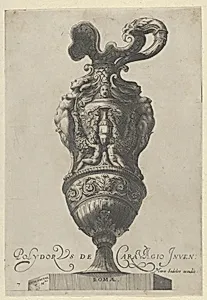
Plate 7: Vase or Ewer Decorated With a Vase Flanked by Putti and Two Large Female figures whose legs morph into griffin claws, from Antique Vases (Vasa a Polydoro Caravagino)
Medium
Etching and engraving; second state of three (Bartsch)
Dimensions
Sheet: 9 1/16 × 6 1/4 in. (23 × 15.8 cm)
Classification
Prints|Ornament & Architecture
Department
Drawings and Prints
Museum
Metropolitan Museum of Art, New York, NY
Credit
The Elisha Whittelsey Collection, The Elisha Whittelsey Fund, 1951
Accession Number
51.501.606
Rights
Public Domain
Tags
Art Historical Context
Welcome to Plate 7 from *Antique Vases (Vasa a Polydoro Caravagino)*, a captivating 1605 etching and engraving by a stellar collaboration: designs attributed to Mannerist masters Cherubino Alberti (after Zaccaria Mattia) and Polidoro da Caravaggio, with exquisite execution by engravers Aegidius Sadeler II and Marcus Sadeler. This second-state impression (per Bartsch) measures a intimate 9 1/16 × 6 1/4 inches and depicts an ornate vase or ewer adorned with a central vase flanked by playful putti (cherubic figures) and two towering female nudes whose legs dramatically morph into griffin claws—a whimsical blend of classical antiquity and fantastical grotesques. Created during the early Baroque era, this print belongs to a renowned series reproducing imaginary ancient vases, drawing from Polidoro da Caravaggio's innovative facade decorations in Rome. Such ornamental prints were essential tools for artists, architects, and craftsmen, disseminating Mannerist motifs like hybrid creatures and nude figures to inspire Renaissance interiors, metalwork, and ceramics across Europe. The Sadeler brothers' precise etching and engraving techniques capture intricate details, from swirling acanthus leaves to the dynamic tension in the griffin-legged sirens, reflecting the era's fascination with rediscovered Roman grotteschi. Housed in the Metropolitan Museum of Art's Drawings and Prints department (Elisha Whittelsey Collection), this work highlights how prints democratized high art, fueling the decorative arts revolution. Imagine 17th-century workshops buzzing with these fantastical designs—timeless inspiration from antiquity's playful reinvention!
About the Artist
Cherubino Alberti (Zaccaria Mattia)|Polidoro da Caravaggio|Aegidius Sadeler II|Marcus Sadeler · 1553–1615
Cherubino Alberti (1553–1615), also known by his birth name Zaccaria Mattia, was an Italian engraver and painter active in Rome during the late Renaissance and early Baroque periods. Born in Borgo San Sepolcro in Tuscany, he came from an artistically inclined family and received training that equipped him for work in both painting and the reproductive graphic arts. It was as a printmaker, however,...