
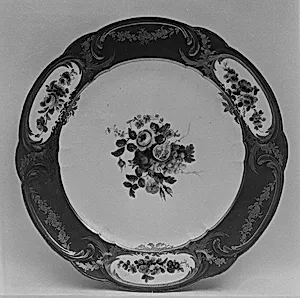
Plate (assiette à palmes) (1 of 102) (part of a service)
Medium
Soft-paste porcelain
Dimensions
Diameter: 9 5/8 in. (24.4 cm)
Classification
Ceramics-Porcelain
Culture
French, Sèvres
Department
European Sculpture and Decorative Arts
Museum
Metropolitan Museum of Art, New York, NY
Credit
Bequest of Emma T. Gary, 1934
Accession Number
37.20.74
Rights
Public Domain
Tags
Art Historical Context
This exquisite plate, titled *Assiette à palmes and one of 102 from a grand porcelain service, was crafted at the renowned Sèvres Manuf in France in 1786. Produced under the patronage of King Louis XVI, Sèvres was Europe's premier porcelain factory, celebrated for its soft-paste porcelain—a delicate, creamy material developed as an early European alternative to costly Chinese hard-paste imports. Measuring 9 5/8 inches in diameter, this plate exemplifies the factory's mastery of fine modeling and vibrant glazing, with gilding attributed to artist Denis Levé. Adorned with lush motifs of grapes and flowers, the decoration reflects the opulent tastes of late 18th-century French aristocracy. These naturalistic designs, hand-painted in rich enamels and accented with gold, evoke abundance and the pleasures of the table, typical of rococo-inspired tableware transitioning toward neoclassicism. Soft-paste allowed for intricate detailing and jewel-like colors that fired brilliantly, making Sèvres pieces status symbols for elite dining. Today, housed in the Metropolitan Museum of Art's European Sculpture and Decorative Arts Department (bequest of Emma T. Gary, 1934), this plate offers a glimpse into pre-Revolutionary luxury. Part of an immense service, it highlights porcelain's role as diplomatic gifts and royal extravagance, bridging art and everyday elegance.
About the Artist
Sèvres Manufactory|Denis Levé · 1740–present
The Sèvres Manufactory, one of Europe's premier porcelain producers, was established in 1740 as the Manufacture de Vincennes under the patronage of Queen Marie Leszczyńska, who sought to rival Meissen and Chantilly porcelains with French soft-paste innovations. Initially a private venture, it relocated to Sèvres in 1756 in a purpose-built facility designed by architect Laurent Lindet near Madame d...