
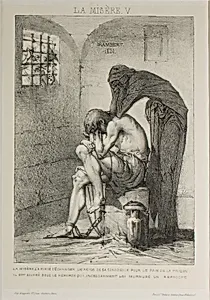
Plate Five from Misery
1851
Medium
Lithograph in black on cream China paper, laid down on ivory wove paper (chine collé)
Dimensions
Image: 23.7 × 17.2 cm (9 3/8 × 6 13/16 in.); Primary support: 27.1 × 19.4 cm (10 11/16 × 7 11/16 in.); Secondary support: 43.3 × 29.7 cm (17 1/16 × 11 3/4 in.)
Classification
lithograph
Department
Prints and Drawings
Museum
Art Institute of Chicago
Accession Number
207051
Rights
Public Domain
Art Historical Context
Charles Rambert’s “Plate Five from Misery,” created in 1851, offers a compelling glimpse into mid-nineteenth-century printmaking. Produced as a lithograph in black ink on cream China paper using the chine collé techniquewhere the delicate image sheet is mounted onto a sturdier support—this work exemplifies the period’s innovative approaches to achieving tonal richness and fine detail in printed art. The layered supports, measuring roughly 27 by 19 centimeters for the primary sheet, allow the image to stand out with subtle contrast against the ivory wove paper beneath. As part of a larger series titled “Misery,” the print likely explores themes of human hardship common in the social consciousness of the era. Lithography’s rise in the 1800s democratized art by enabling artists to reach wider audiences beyond traditional painting collectors. Now housed in the Art Institute of Chicago’s Department of Prints and Drawings, this piece highlights how such techniques preserved both artistic expression and historical commentary for future generations.