
Plate Fragment
Unknown Artist
14th–15th century
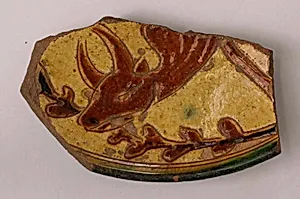
Medium
Earthenware; incised decoration through white slip and coloring under transparent glaze
Classification
Ceramics
Department
Islamic Art
Museum
Metropolitan Museum of Art, New York, NY
Credit
Rogers Fund, 1966
Accession Number
66.95.11
Rights
Public Domain
Tags
Art Historical Context
This exquisite plate fragment, dating to the 14th–15th century, hails from the rich tradition of Islamic ceramics and offers a glimpse into medieval artistry. Crafted from earthenware, features intricate incised decoration created by applying a white slip—a liquid clay mixture—over the body, then scratching through it to reveal contrasting layers beneath. Vibrant coloring was added before a transparent glaze sealed the design, producing a luminous, jewel-like effect that was highly prized in Islamic workshops. The fragment likely depicts animals, a motif common in Islamic art symbolizing vitality, nature, and sometimes allegorical themes. This sgraffito technique (from the Italian for "scratched") exemplifies the technical sophistication of potters in regions like Persia or the Levant during this era, where ceramics served both daily use and luxurious display. Such pieces circulated widely through trade routes, blending functionality with storytelling. Acquired through the Rogers Fund in 1966, this artifact at the Metropolitan Museum of Art invites us to appreciate the enduring elegance of Islamic decorative arts, where everyday objects became canvases for creativity and cultural expression.