
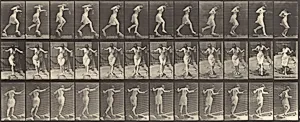
Plate Number 175. Crossing brook on stepping-stones with a fishing pole and can
Medium
collotype
Dimensions
image: 17.2 × 42.1 cm (6 3/4 × 16 9/16 in.) sheet: 47.5 × 60.1 cm (18 11/16 × 23 11/16 in.)
Classification
Photograph
Department
CPH
Museum
National Gallery of Art, Washington, D.C.
Credit
Corcoran Collection (Museum Purchase, 1887)
Accession Number
2014.79.220
Rights
Public Domain
Art Historical Context
**Plate Number 175: Crossing on Stepping-Stones a Fishing Pole and Can Eadweard Muybridge *Plate Number 175* (1887) is a captivating collotype print from his monumental *Animal Locomotion*, a landmark in photographic history. Capturing a nude figure mid-stride across a brook—balancing a fishing pole and can in hand—this image freezes sequential moments of human movement in a naturalistic setting. Measuring 17.2 × 42.1 cm, it exemplifies Muybridge's innovative approach, blending art and science during the late 19th century's fascination with motion and realism. Muybridge, a British-American photographer, revolutionized the field by using banks of up to 24 cameras triggered in rapid succession, decomposing everyday actions into precise sequences. The collotype medium—a finely detailed printing process—allowed high-fidelity reproduction of these studies, making them accessible for scientific and artistic study. Originally purchased for the Corcoran Gallery in 1887, this work now resides in the National Gallery of Art's Corcoran Collection. This plate highlights Muybridge's influence on modern cinema and biomechanics, proving that a horse's gallop (famously debunked earlier) and human gait could be visually dissected. For visitors, it offers a window into Victorian-era innovation, where photography bridged empirical science with aesthetic wonder.
About the Artist
Eadweard Muybridge · 1830–1904
Eadweard Muybridge (1830-1904) was an English-American photographer who revolutionized the understanding of motion through his pioneering chronophotographic studies. Born Edward James Muggeridge in Kingston upon Thames, England, he emigrated to America and became famous first for his dramatic landscape photographs of Yosemite Valley, then for his groundbreaking motion studies that proved horses li...