
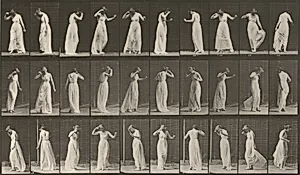
Plate Number 194. Dancing
Medium
collotype
Dimensions
image: 20 × 34.3 cm (7 7/8 × 13 1/2 in.) sheet: 47.65 × 60.2 cm (18 3/4 × 23 11/16 in.)
Classification
Photograph
Department
CPH
Museum
National Gallery of Art, Washington, D.C.
Credit
Corcoran Collection (Museum Purchase, 1887)
Accession Number
2014.79.237
Rights
Public Domain
Art Historical Context
Eadweard Muybridge *Plate Number 194.* (1887) captures the fluid grace of human motion in a groundbreaking collotype print from his seminal *Animal Locomotion* series Muybridge, a pioneering photographer, used a battery of 24 cameras triggered sequentially to freeze successive moments of a dancer's performance, revealing body's intricate rhythms invisible to the naked eye. This 20 × 34.3 cm image, part of the National Gallery of Art's Coran Collection, exemplifies his obsession with dissecting movement, born from his earlier proof that a trotting horse lifts all four hooves off the ground. Printed via collotype—a precise photomechanical process that allowed faithful reproduction of photographic details—this plate holds immense artistic and scientific significance. Muybridge's work bridged photography and science, influencing early cinema pioneers like the Lumière brothers and Eadweard Muybridge's own zoopraxiscope projections. Culturally, it challenged Victorian norms by often featuring nude models, sparking debates on anatomy, art, and propriety while advancing chronophotography as a vital tool for artists and anatomists. Today, *Dancing* invites visitors to marvel at motion's poetry, reminding us how Muybridge transformed a static medium into a dynamic study of life itself.
About the Artist
Eadweard Muybridge · 1830–1904
Eadweard Muybridge (1830-1904) was an English-American photographer who revolutionized the understanding of motion through his pioneering chronophotographic studies. Born Edward James Muggeridge in Kingston upon Thames, England, he emigrated to America and became famous first for his dramatic landscape photographs of Yosemite Valley, then for his groundbreaking motion studies that proved horses li...