
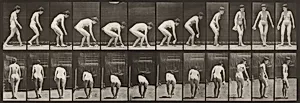
Plate Number 220. Stooping, and lifting handkerchief and turning
Medium
collotype
Dimensions
image: 15.7 × 45.4 cm (6 3/16 × 17 7/8 in.) sheet: 48.2 × 61.1 cm (19 × 24 1/16 in.)
Classification
Photograph
Department
CPH
Museum
National Gallery of Art, Washington, D.C.
Credit
Edward E. MacCrone Fund
Accession Number
2019.131.3
Rights
Public Domain
Art Historical Context
Eadweard Muybridge *Plate Number 220.oping, and lifting handkerchief turning* (1887) is a entry from his groundbreaking *Animal Locomotion* series a monumental 11-volume publication of 781 collotype plates. A British-born photographer who settled in America, Muybridge pioneered high-speed photography in the 1870s, famously proving that all four hooves of a galloping horse leave the groundsparking a revolution in our understanding of motion. Commissioned by the University of Pennsylvania, this series expanded his animal studies to include nude and draped human figures performing everyday actions, blending scientific inquiry with artistic precision. Printed as a collotype—a photomechanical process that faithfully reproduced fine details on a large sheet (48.2 × 61.1 cm)—this plate sequences a figure mid-motion: stooping to pick up a handkerchief and turning. The 15.7 × 45.4 cm image captures 12 instantaneous exposures, freezing subtle shifts in posture, fabric folds, and gesture that the naked eye misses. Such innovations influenced early cinema, chronophotography pioneers like Étienne-Jules Marey, and modern artists exploring movement. Today, housed in the National Gallery of Art thanks to the Edward E. MacCrone Fund, this work reminds us how Muybridge transformed photography from static portraiture into a dynamic tool for dissecting life's rhythms, bridging art, science, and human curiosity.
About the Artist
Eadweard Muybridge · 1830–1904
Eadweard Muybridge (1830-1904) was an English-American photographer who revolutionized the understanding of motion through his pioneering chronophotographic studies. Born Edward James Muggeridge in Kingston upon Thames, England, he emigrated to America and became famous first for his dramatic landscape photographs of Yosemite Valley, then for his groundbreaking motion studies that proved horses li...