
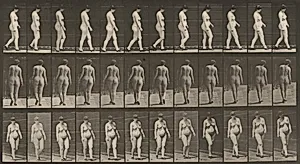
Plate Number 24. Walking with shoes on
Medium
collotype
Dimensions
image: 20.2 × 36.5 cm (7 15/16 × 14 3/8 in.) sheet: 48 × 60.4 cm (18 7/8 × 23 3/4 in.)
Classification
Photograph
Department
CPH
Museum
National Gallery of Art, Washington, D.C.
Credit
Corcoran Collection (Museum Purchase, 1887)
Accession Number
2014.79.76
Rights
Public Domain
Art Historical Context
Eadweard Muybridge's *Plate Number 24. with Shoes On* (1887) captures a pivotal moment in the history of photography and scientific visualization. Part of Muybridge's groundbreaking *Animal Locomotion*, this collotype print freezes a human figure mid-stride, revealing the intricate mechanics of movement. Muybridge, a British-born photographer working in America, became famous for using banks of up to 24 cameras triggered sequentially to dissect motion, debunking myths like whether a trotting horse ever has all four hooves off the ground. This plate exemplifies Muybridge's fusion of art and science, produced via collotype—a precise printing technique that allowed faithful reproduction of photographic details on a large scale (sheet: 48 × 60.4 cm). The image's clinical yet rhythmic presentation influenced early filmmakers like the Lumière brothers and artists exploring dynamism, from Marcel Duchamp to contemporary animators. Acquired by the Corcoran Gallery in 1887 and now in the National Gallery of Art's collection, it invites viewers to ponder how everyday actions like walking hold profound revelations about the body in motion. Fun fact: Muybridge's studies stemmed from a famous wager with railroad magnate Leland Stanford, sparking a visual revolution that bridged Victorian curiosity with modern media. Step into the frame and feel the pulse of progress!
About the Artist
Eadweard Muybridge · 1830–1904
Eadweard Muybridge (1830-1904) was an English-American photographer who revolutionized the understanding of motion through his pioneering chronophotographic studies. Born Edward James Muggeridge in Kingston upon Thames, England, he emigrated to America and became famous first for his dramatic landscape photographs of Yosemite Valley, then for his groundbreaking motion studies that proved horses li...