
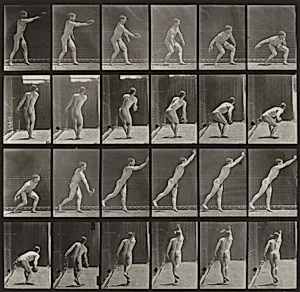
Plate Number 307. Throwing an iron disk
Medium
collotype
Dimensions
image: 26.3 × 27.1 cm (10 3/8 × 10 11/16 in.) sheet: 48.5 × 61.1 cm (19 1/8 × 24 1/16 in.)
Classification
Photograph
Department
CPH
Museum
National Gallery of Art, Washington, D.C.
Credit
Corcoran Collection (Museum Purchase, 1887)
Accession Number
2014.79.333
Rights
Public Domain
Art Historical Context
Behold *Plate Number 307. Throwing an Iron Disk* by Eadweard Muy, a captivating 1887 collotype from his groundbreaking *Animal Locomotion*. Captured at the University of Pennsylvania, this image freezes a dynamic moment of an athlete hurling a discus, part of Muybridge's exhaustive study of human and animal movement through sequential photography. Printed in rich detail on a large 48.5 × 61.1 cm sheet, the 26.3 × 27.1 cm image exemplifies collotype's precision—a photomechanical process that allowed high-fidelity reproductions of his original motion plates. Muybridge, a British-born innovator, revolutionized photography in the late 19th century by using multiple cameras triggered in rapid succession, debunking myths about motion (like galloping horses with all hooves off the ground). This plate, acquired by the Corcoran Gallery in 1887 and now in the National Gallery of Art's Corcoran Collection, highlights his scientific rigor and artistic vision, bridging art, science, and early cinema precursors. Fun fact: Muybridge's work inspired filmmakers like the Lumière brothers and even modern stop-motion animation. Gaze closely at the athlete's poised form—mid-throw elegance captured forever, inviting us to ponder the poetry of movement in a single, frozen frame.
About the Artist
Eadweard Muybridge · 1830–1904
Eadweard Muybridge (1830-1904) was an English-American photographer who revolutionized the understanding of motion through his pioneering chronophotographic studies. Born Edward James Muggeridge in Kingston upon Thames, England, he emigrated to America and became famous first for his dramatic landscape photographs of Yosemite Valley, then for his groundbreaking motion studies that proved horses li...