
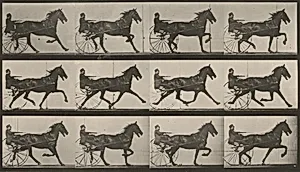
Plate Number 606. "Reuben" trotting, harnessed to sulky
Medium
collotype
Dimensions
image: 20.5 × 35.6 cm (8 1/16 × 14 in.) sheet: 47.63 × 60.33 cm (18 3/4 × 23 3/4 in.)
Classification
Photograph
Department
CPH
Museum
National Gallery of Art, Washington, D.C.
Credit
Corcoran Collection (Museum Purchase, 1887)
Accession Number
2014.79.573
Rights
Public Domain
Art Historical Context
Step into the pioneering world of motion photography with *Plate Number 606. "Reuben" tro, harnessed to sulky* by Eadweard Muy, created in 1887. This collotype print captures the horse Reuben in mid-stride, pulling a lightweight sulky cart—a two-wheeled vehicle used in harness racing. Muybridge, a British-American photographer renowned for his groundbreaking *Animal Locomotion* series produced over 780 plates like this one, each featuring sequential images that freeze animal movement across 12 to 24 cameras triggered in rapid succession. The artwork's historical significance lies in Muybridge's quest to settle the age-old debate about how horses truly gallop, proving they lift all four hooves off the ground at once. His techniques revolutionized science, art, and early film, influencing figures like Thomas Edison and the birth of cinema. Printed via collotype—a precise photomechanical process that rivaled the detail of original negatives—this 20.5 × 35.6 cm image on a larger 47.63 × 60.33 cm sheet allowed widespread study of anatomy and kinetics. Acquired by the Corcoran Gallery in 1887 and now in the National Gallery of Art's Corcoran Collection, this piece invites us to marvel at the blend of artistry and innovation, turning a trotting horse into a timeless icon of visual science.
About the Artist
Eadweard Muybridge · 1830–1904
Eadweard Muybridge (1830-1904) was an English-American photographer who revolutionized the understanding of motion through his pioneering chronophotographic studies. Born Edward James Muggeridge in Kingston upon Thames, England, he emigrated to America and became famous first for his dramatic landscape photographs of Yosemite Valley, then for his groundbreaking motion studies that proved horses li...