
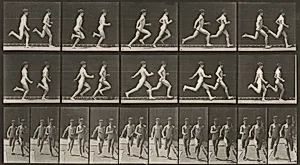
Plate Number 69. Two men running
Medium
collotype
Dimensions
image: 20.1 × 36.1 cm (7 15/16 × 14 3/16 in.) sheet: 47.7 × 60.2 cm (18 3/4 × 23 11/16 in.)
Classification
Photograph
Department
CPH
Museum
National Gallery of Art, Washington, D.C.
Credit
Corcoran Collection (Museum Purchase, 1887)
Accession Number
2014.79.120
Rights
Public Domain
Art Historical Context
Eadweard Muybridge’s *Plate Number 69. Two men running* belongs to his groundbreaking 1887 publication *Animal Locomotion*, a monumental study of human and animal movement. Working at the University of Pennsylvania, Muybridge employed a battery of cameras triggered in rapid succession to freeze successive instants of motion. The resulting sequences revealed details invisible to the naked eye, such as the precise coordination of limbs during a run, and helped lay the foundation for modern cinema and animation. Printed as a collotype—a fine-screen photographic process prized for its rich tonal range—this sheet measures just over seven by fourteen inches within a much larger support. The two runners appear across twelve consecutive frames, their bodies captured against a calibrated grid that allowed scientists and artists to measure stride and posture with unprecedented accuracy. Beyond its scientific value, the plate embodies the late-nineteenth-century fascination with time, speed, and the body. Muybridge’s methodical images transformed everyday actions into objects of aesthetic and intellectual contemplation, inviting viewers to reconsider how we perceive motion itself.
About the Artist
Eadweard Muybridge · 1830–1904
Eadweard Muybridge (1830-1904) was an English-American photographer who revolutionized the understanding of motion through his pioneering chronophotographic studies. Born Edward James Muggeridge in Kingston upon Thames, England, he emigrated to America and became famous first for his dramatic landscape photographs of Yosemite Valley, then for his groundbreaking motion studies that proved horses li...