
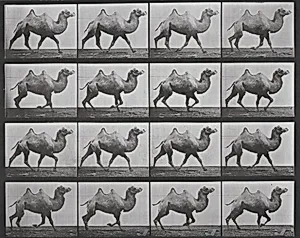
Plate Number 738. Bactrian camel walking
Medium
collotype
Dimensions
image: 24.13 × 29.85 cm (9 1/2 × 11 3/4 in.) sheet: 47.63 × 60.33 cm (18 3/4 × 23 3/4 in.)
Classification
Photograph
Department
CPH
Museum
National Gallery of Art, Washington, D.C.
Credit
Corcoran Collection (Museum Purchase, 1887)
Accession Number
2014.79.663
Rights
Public Domain
Art Historical Context
Step into the groundbreaking world of motion photography with *Plate Number 738. Bactrian Walking* by Eadweard Muybridge, created in 1887. This collotype print, part of Muybridge's monumental *Animal Locomotion* series captures the rare Bactrian camel—a shaggy, two-humped desert dweller from Central Asia—in mid-stride. Measuring nearly 10 by 12 inches on a larger 19 by 24-inch sheet, it exemplifies the precision of 19th-century scientific artistry, now housed in the National Gallery of Art's Corcoran Collection. Muybridge, a British-born innovator, revolutionized visual culture by using a battery of up to 24 cameras triggered sequentially to "freeze" animal movement, debunking myths like the horse's gait. Published as one of 781 plates, this image highlights the camel's deliberate, swaying walk, blending art with emerging zoological science. Collotype, a photomechanical process, allowed exquisite detail reproduction, making these studies accessible to scholars and artists alike. This work's legacy endures: Muybridge's sequential frames paved the way for cinema and modern animation, influencing everyone from Thomas Edison to contemporary filmmakers. Imagine Victorian audiences marveling at a camel's hidden rhythms— a testament to curiosity's power to transform how we see the world.
About the Artist
Eadweard Muybridge · 1830–1904
Eadweard Muybridge (1830-1904) was an English-American photographer who revolutionized the understanding of motion through his pioneering chronophotographic studies. Born Edward James Muggeridge in Kingston upon Thames, England, he emigrated to America and became famous first for his dramatic landscape photographs of Yosemite Valley, then for his groundbreaking motion studies that proved horses li...