
Plate of a Belt Buckle
Unknown Artist
6th–7th century
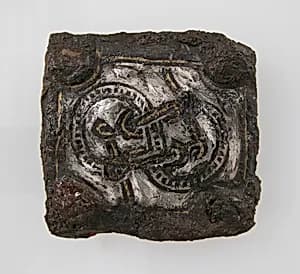
Medium
Iron, silver, brass
Dimensions
Overall: 1 5/8 x 1 9/16 x 5/16 in. (4.1 x 3.9 x 0.8 cm)
Classification
Metalwork-Iron
Culture
Frankish
Department
Medieval Art
Museum
Metropolitan Museum of Art, New York, NY
Credit
Gift of J. Pierpont Morgan, 1917
Accession Number
17.191.308
Rights
Public Domain
Art Historical Context
This delicate plate from a Frankish buckle, crafted in the 6th–7th century, exemplifies exquisite metalwork of early medieval Europe. Measuring just 1⅝ × 1⁹⁄₁₆ × ₅⁄₁₆ inches, it combines a sturdy iron base with overlays of silver and brass, creating a harmonious blend of durability and ornamentation. Such buckles were not mere fasteners but symbols of status, adorning belts that held swords, pouches, or tunics for warriors and elitesHailing from Frankish culture—associated with the Merovingian dynasty that dominated Gaul (modern France and Germany)—this reflects a time of transition from late antiquity to the Middle Ages. Frankish artisans drew on Roman techniques while innovating with local materials, often inlaying non-ferrous metals like silver and brass into iron for decorative effect. This method highlighted their skill in chasing, niello, or gilding, though specifics here remain tantalizingly elusive due to unknown maker. Now housed in the Metropolitan Museum of Art's Medieval Art department, to a 1917 gift from J. Pierpont Morgan, it offers a window into everyday luxury among the Franks. Imagine a chieftain striding through a misty forest his buckle glinting—a tiny testament to craftsmanship that bridged empires and eras.