
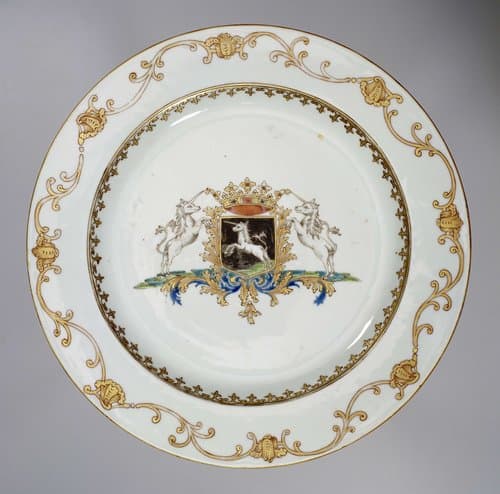
Plate with the Van Beeftingh Family Coat of Arms
c. 1745
Medium
turning
Dimensions
2.7; 23; 13
Rights
Public Domain
About this artwork
diameter 13 cm
Art Historical Context
### Plate with the Van Beeftingh Family Coat of Arms This delicate plate, created around 1745 by an anonymous artisan, proudly displays the coat of arms of the Van Beeftingh family, a symbol of lineage and prestige in 18th-century Europe. Measuring just 2.7 cm in height and 23 cm in diameter (with an alternative record noting 13 cm), its shallow, saucer-like form suggests it was designed for display or ceremonial use rather than everyday dining, evoking the opulence of affluent households. Crafted using the "turning" technique—likely wheel-thrown on a potter's lathe—this piece highlights skilled craftsmanship typical of period ceramics workshops. Turning allowed for precise, symmetrical shapes, emphasizing the heraldic emblem at the center. In the context of the mid-1700s, such personalized tableware underscored family identity and social standing, often produced in regions like the Netherlands where Dutch surnames like Van Beeftingh were common. Though anonymous, the plate reflects broader cultural traditions of heraldry in decorative arts, blending utility with symbolism. A charming glimpse into Enlightenment-era domestic pride, it invites us to ponder the stories behind its gilded lineage.
About the Artist
anonymous
In the vast tapestry of art history, "Anonymous" stands not as a singular individual but as a collective designation for countless unidentified creators whose works have endured across millennia. These artists, spanning prehistoric cave painters to medieval illuminators and folk craftsmen, produced the foundational layers of human visual culture. Prior to the Renaissance, when individual fame emer...