
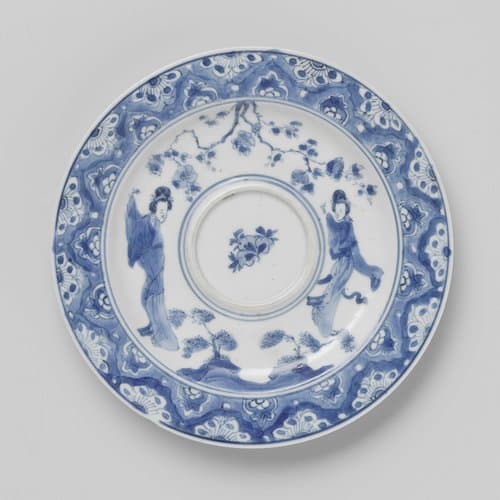
Plate with two women and prunus spray
c. 1680 - c. 1720
Medium
turning
Dimensions
2; 9.8; 18.4
Rights
Public Domain
About this artwork
Schenking van de erven van P.C.E. von Hemert-van der Meulen
Art Historical Context
This delicate plate, titled *Plate with two women andunus spray*, showcases an anonymous artist's skill from around 1680–1720, a period bridging Europe's Baroque era and the dawn of Rococo tastes. Measuring just 2 cm in height and 18.4 cm in diameter, it's shallow, intimate dish perfect for serving sweets or displaying as a collector's trinket. The decoration features two elegant women—likely inspired by East Asian imagery—flanked by a sprig of prunus (plum blossom), a motif symbolizing resilience and the fleeting beauty of spring in Chinese culture, which captivated European audiences through expanding trade routes. Crafted using the "turning" technique—precisely shaping the form on a lathe or potter's wheel—this plate exemplifies the meticulous craftsmanship of the late 17th and early 18th centuries. Such methods allowed for smooth, symmetrical curves, highlighting the object's functionality and aesthetic refinement. Produced amid the Dutch Golden Age's obsession with Asian imports like Kangxi porcelain, it reflects the era's cultural exchange, blending Eastern motifs with Western production techniques in places like Delft. A generous gift from the heirs of P.C.E. von Hemert-van der Meulen, this piece invites visitors to ponder the global threads woven into everyday objects, bridging continents and centuries in a single, blooming glance.
About the Artist
anonymous
In the vast tapestry of art history, "Anonymous" stands not as a singular individual but as a collective designation for countless unidentified creators whose works have endured across millennia. These artists, spanning prehistoric cave painters to medieval illuminators and folk craftsmen, produced the foundational layers of human visual culture. Prior to the Renaissance, when individual fame emer...