
頼山陽書 祇園南海筆墨竹図打掛に於いて|Poem Accompanying an Over Robe (Uchikake) with Bamboo by Gion Nankai (1677–1751)
dated 1824
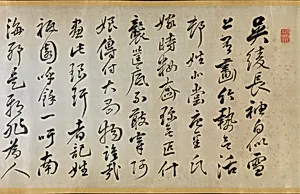
Medium
Handscroll; ink on silk
Dimensions
11 7/8 x 116 3/4 in. (30.2 x 296.5 cm)
Classification
Calligraphy
Culture & Period
Japan · Edo period (1615–1868)
Department
Asian Art
Museum
Metropolitan Museum of Art, New York, NY
Credit
The Harry G. C. Packard Collection of Asian Art, Gift of Harry G. C. Packard, and Purchase, Fletcher, Rogers, Harris Brisbane Dick, and Louis V. Bell Funds, Joseph Pulitzer Bequest, and The Annenberg Fund Inc. Gift, 1975
Accession Number
1975.268.89
Rights
Public Domain
Art Historical Context
This elegant handscroll, created in 1824 during Japan’s Edo period, preserves a poem by the celebrated scholar, historian, and poet Rai San’yō. The work was composed to accompany an uchikake—an embroidered over robe—decorated with bamboo by the earlier literati painter Gion Nankai (1677–1751). In Edo-period culture, such pairings of calligraphy and painting celebrated the refined interplay between poetry, nature imagery, and personal expression, often shared among cultivated circles. Executed in ink on silk, the handscroll format invites viewers to unroll the work gradually, experiencing the rhythm of Rai’s brushstrokes and the flow of his verse. Classified primarily as calligraphy, the piece exemplifies the literati ideal in which writing itself became an art form, conveying both literary content and the artist’s distinctive personality through varying line weight and spacing. Bamboo, a frequent motif in East Asian art, symbolizes resilience and integrity; here it links Nankai’s painted robe to Rai’s poetic tribute, underscoring themes of scholarly friendship and aesthetic appreciation that flourished in the late Edo era.