
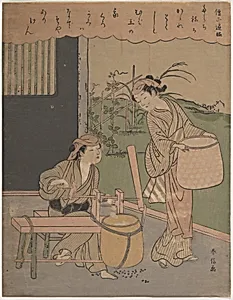
百人一首 僧正遍昭|Poem by Henjō Sojō
ca. 1766
Medium
Woodblock print; ink and color on paper
Dimensions
H. 10 9/16 in. (26.8 cm); W. 8 3/16 in. (20.8 cm)
Classification
Prints
Culture & Period
Japan · Edo period (1615–1868)
Department
Asian Art
Museum
Metropolitan Museum of Art, New York, NY
Credit
H. O. Havemeyer Collection, Bequest of Mrs. H. O. Havemeyer, 1929
Accession Number
JP1636
Rights
Public Domain
Tags
Art Historical Context
This woodblock print by Suzuki Harunobu, created around 1766 during Japan’s Edo period, belongs to a series illustrating poems from the beloved Hyakunin Isshu anthology. The title references the verse by Henjō Sojō, a ninth-century Buddhist monk and poet, pairing classical literature with the refined visual language of ukiyo-e. Harunobu, celebrated for his pioneering use of full-color nishiki-e printing, brought a delicate elegance to such works, transforming poetic themes into intimate scenes often featuring women. Printed with ink and color on paper, the modest size invites close viewing, reflecting the growing popularity of affordable art among Edo’s urban audiences. Harunobu’s graceful lines and subtle palette capture the refined sensibility of the period, when poetry, nature, and daily life intertwined in popular culture. Acquired through the H. O. Havemeyer bequest, this piece now offers museum visitors a window into the harmonious blend of literature and visual art that defined eighteenth-century Japan.
About the Artist
Suzuki Harunobu · 1725–1770
Suzuki Harunobu (c. 1725-1770) was a Japanese ukiyo-e artist who revolutionized woodblock printing by developing nishiki-e—full-color prints using multiple woodblocks—in 1765. Before Harunobu, Japanese prints were limited to two or three colors; his innovation unleashed the entire artist's palette, transforming ukiyo-e into the vibrant art form that would later captivate Western artists from Manet...