
Polynesian Woman with Children
1901
Medium
Oil on linen canvas
Dimensions
97 × 74 cm (38 3/16 × 29 1/8 in.); Framed: 111.2 × 88.3 × 5.8 cm (43 3/4 × 34 3/4 × 2 1/4 in.)
Classification
oil on canvas
Department
Painting and Sculpture of Europe
Museum
Art Institute of Chicago
Accession Number
34461
Rights
Public Domain
About this artwork
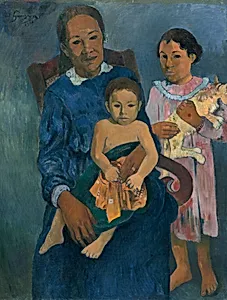
The three figures in this work have never been identified. Their familial pose and other details, such as the woman’s gold ring and the red mark on the girl’s hand, invite speculation as to their relationship to each other and to the artist. Technical analysis has revealed that Paul Gauguin reworked the position of the woman’s hands to align diagonally with those of the young girl standing behind her. Together, they form an upward axis reinforced by the cat, also a later addition.
Art Historical Context
**Polynesian Woman with Children painted by Paul Gauguin in 1901, captures the artist's deep immersion in Polynesian life during his final years in the South Pacific. Having fled the industrialization of Europe, Gauguin settled in the Marquesas Islands where he created this poignant oil on linen canvas (97 × 74 cm) as one of his last major works before his death in 1903. The reflects his fascination with indigenous culture, portraying a serene Polynesian woman cradling her children in a harmonious, almost mythical tableau that idealizes maternal bonds and tropical paradise. Gauguin's Post-Impressionist style shines through in his bold, flattened forms, vibrant colors, and strong outlines—a technique known as cloisonnism, inspired by stained glass and Japanese prints. The linen canvas provided a smooth, durable surface for his luminous oils, allowing rich textures that evoke the warmth of sunlight and lush foliage. This departure from realistic perspective emphasized emotional and symbolic depth over photographic accuracy. Housed in the Art Institute of Chicago's Department of Painting and Sculpture of Europe, the work exemplifies Gauguin's primitivist vision, influencing modern artists like the Fauves and Expressionists. It invites visitors to ponder themes of escape, exoticism, and cultural reverence, offering a window into the artist's quest for an unspoiled Eden.
About the Artist
Paul Gauguin · 1848–1903
Paul Gauguin (1848-1903) was a French Post-Impressionist painter whose bold experiments with color, form, and subject matter made him one of the most influential figures in the transition from 19th-century art to modernism. His rejection of European civilization for the perceived authenticity of 'primitive' cultures established an archetype of artistic exile that continues to resonate. Gauguin's ...