
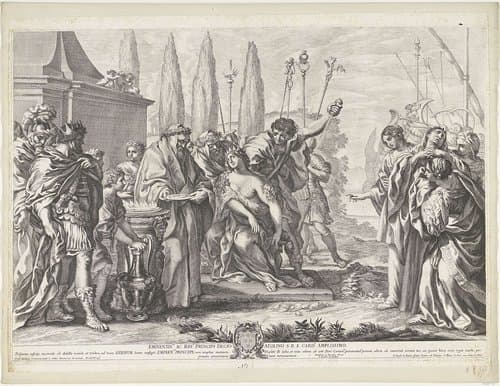
Polyxena bij het graf van Achilles geofferd
1660 - 1692
Medium
etching
Dimensions
440; 627
Rights
Public Domain
About this artwork
verzamelaarsmerk, verso, gestempeld: Lugt 240
Art Historical Context
**Polyxena Sacrificed at the Tomb Achilles** Step into the dramatic world of ancient mythology with *Polyxena bij het graf Achilles geofferd*Polyxena Sacrificed at the Tomb Achilles), a powerful etching by Italian artist Pietro Aquila, created between 1660 and1692. This scene depicts the heart-wrenching moment from Greek legend when the Trojan princess Polyxena is offered as a sacrificial victim on Achilles' grave to appease his restless spirit—a tale echoed in classical texts like Euripides' *Hecuba*. Aquila, a prominent Roman engraver of the Baroque era, specialized in reproductive prints that brought grand historical and mythological narratives to life, making elite art accessible to wider audiences through the burgeoning print market. Measuring an impressive 440 × 627 mm, this etching exemplifies the medium's technical brilliance. By coating a metal plate with acid-resistant ground and scratching lines for the acid to etch, Aquila achieved intricate details, fluid shading, and emotional depth suited to the theatrical intensity of 17th-century Baroque style. Prints like this fueled Europe's collector culture, preserving dramatic compositions for study and admiration. A collector's mark stamped on the verso (Lugt 240) highlights its esteemed provenance, linking it to historic connoisseurs. This work invites us to ponder timeless themes of fate, vengeance, and heroism through masterful printmaking.
About the Artist
Pietro Aquila · 1592–1692
Comment on works: History; Engraver