
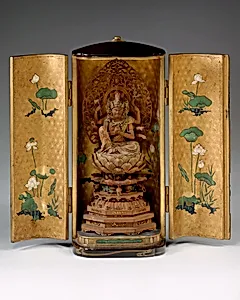
厨子入馬頭漢音坐像|Portable Shrine with Batō, Horse-Headed Kannon (Hayagriva Avalokiteshvara)
Unknown Artist
ca. 1620
Medium
Fruitwood with cut-out gold; lacquered case with maki-e decoration
Dimensions
Portable shrine: H. 7 3/4 in. (19.7 cm); W. 3 1/2 in. (8.9 cm); D. 3 in. (7.6 cm) Statue: H. 2 5/16 in. (5/9 cm)
Classification
Sculpture
Culture & Period
Japan · Edo period (1615–1868)
Department
Asian Art
Museum
Metropolitan Museum of Art, New York, NY
Credit
Purchase, Friends of Far Eastern Art Gifts, 1985
Accession Number
1985.96
Rights
Public Domain
Tags
Art Historical Context
This exquisite portable shrine, crafted around 1620 during Japan's Edo period (16151868), houses a diminutive fruitwood statue of Batō Kannon the horse-headed form of the bodhisattva AvalokiteshvaraHayagrīva). Known for his fierce expression and protective powers, Batō Kannon embodies wrathful compassion in Buddhist tradition, warding off evil spirits and aiding devotees—often invoked by travelers or those facing peril. The shrine's compact size (just under 8 inches tall) made it ideal for personal devotion, carried by pilgrims or placed in homes as a talisman. The statue gleams with intricate cut-out gold overlay on fruitwood, creating a luminous, openwork effect that highlights dynamic details like flowing lotuses, symbols of purity rising from mud. Encased in a lacquered box adorned with maki-e—gold powder sprinkled into wet lacquer for shimmering motifs—the piece showcases Edo-era mastery of mixed media, blending sculpture and decorative arts for both aesthetic and spiritual impact. Acquired by the Metropolitan Museum of Art in 1985, this rare survivor reflects Japan's vibrant Buddhist culture under the Tokugawa shogunate, where portable icons bridged temple rituals and everyday faith, offering portable serenity amid a peaceful yet hierarchical era.