
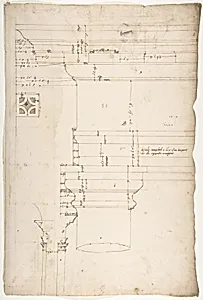
Portico at the Porta Carmentalis, Tuscan capital and entablature, elevation; pier, section, detail (recto) S. Prassede, Quadriportico, Doric capital, elevation; Palazzo Massimo alle Colonne, column shaft, profile (verso)
early to mid-16th century
Medium
Dark brown ink, black chalk, and incised lines
Dimensions
sheet: 17 5/16 x 11 5/8 in. (44 x 29.5 cm)
Classification
Drawings|Ornament & Architecture
Department
Drawings and Prints
Museum
Metropolitan Museum of Art, New York, NY
Credit
Purchase, Rogers Fund, Joseph Pulitzer Bequest, and Mark J. Millard Gift, 1968
Accession Number
68.769.29
Rights
Public Domain
Tags
Art Historical Context
This exquisite 16th-century architectural drawing, created by an anonymous French artist captures the enduring fascination with ancient Roman design during the Renaissance. On the recto, it details the Tuscan capital, entabl, pier section, and elevation from the Portico at the Carmentalis—a gateway in Rome linked to the goddess Carmentis. The features a Doric capital from the Quadportico at S. Prassede basilica and a column shaft profile from Palazzo Massimo Colonne, showcasing a blend of classical orders that influenced European architecture. Produced in the early to mid-1500s, this sheet reflects the era's scholarly passion for antiquity, as French artists and architects traveled to Rome to measure and sketch ruins firsthand. Such drawings served as vital references for reconstructing classical forms, bridging ancient engineering with Renaissance revival styles like those of Palladio. Housed in the Metropolitan Museum of Art's Drawings and Prints department, it highlights how precise studies fueled innovations in ornament and proportion. Crafted with dark brown ink, black chalk, and incised lines—likely for tracing onto other surfaces—the work demonstrates virtuoso technical skill. Its 17 5/16 x 11 5/8-inch sheet preserves the tactile precision of on-site documentation, offering visitors a window into the meticulous world of Renaissance draftsmen.