
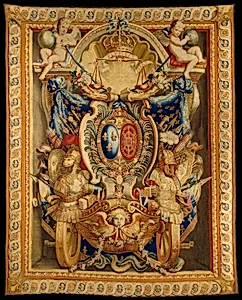
Portiere with the Arms of France and Navarre
late 17th century
Medium
Wool and silk (19 to 20 warps to one inch)
Dimensions
11 ft. 2 in. × 8 ft. 9 1/2 in. (340.4 × 268 cm)
Classification
Textiles-Tapestries
Culture
French, Paris
Department
European Sculpture and Decorative Arts
Museum
Metropolitan Museum of Art, New York, NY
Credit
Gift of Thomas Emery, 1954
Accession Number
54.149
Rights
Public Domain
Tags
Art Historical Context
This magnificent *Portière with the Arms of France and Navarre*, woven at the renowned Manufacture Nationale des Gobel in late 17th Paris, exemplifies the opulence of Louis XIV's court. Designed under the direction of Charles Le Brun, king's premier painter and Gobelins director, it served as a grand doorway curtain (*portière*) in royal or noble interiors. The central coat of arms proudly displays the heraldic symbols of France and Navarre, encircled by playful putti (cherubic figures), coiled snakes, and ornate armor—evoking power, protection, and divine favor during France's Baroque golden age. Crafted from luxurious wool and silk with an impressive 19 to 20 warps per inch, this tapestry showcases the Gobelins' mastery of haute lisse weaving, where vertical looms produced extraordinarily fine, painterly detail rivaling oil paintings. At over 11 feet high and 8 feet wide, its scale filled architectural doorways, transforming spaces into statements of absolutist prestige. Today, gifted to the Metropolitan Museum of Art in 1954, it invites us to marvel at the fusion of artistry and propaganda that defined Versailles-era France.