
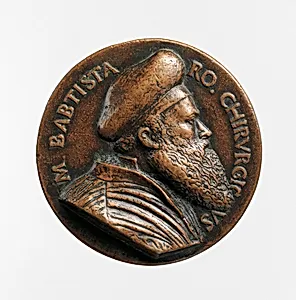
Portrait medal of Battista Vigo da Rapallo or Baptista Romanus (obverse); a Hand Holding a Branch and a Surgical Instrument
Unknown Artist
model ca. 1510 (later aftercast)
Medium
Bronze (copper alloy with light brown patina and remnants of black wax or lacquer).
Dimensions
Diam. 6.4 cm, wt. 119.59 g
Classification
Medals
Culture
Italian, Venice or Padua (?)
Department
Robert Lehman Collection
Museum
Metropolitan Museum of Art, New York, NY
Credit
Robert Lehman Collection, 1975
Accession Number
1975.1.1258
Rights
Public Domain
Tags
Art Historical Context
This Renaissance portrait medal, modeled around 1510 and later cast in bronze, captures the profile of Battista Vigo da Rapallo (also known as Baptista Romanus likely a prominent figure from northern Italy. Produced in Venice or Padua—hubs of early 16th-century medal-making—the obverse features a classical-style bust portrait, evoking ancient Roman coins revived during the humanist Renaissance. These small, collectible discs (here, 6.4 cm in diameter weighing nearly 120 grams) served as personal emblems for scholars, patrons, and professionals, blending art with identity. The reverse depicts a symbolic hand grasping a branch—perhaps an olive symbolizing healing or peace—and a surgical instrument, hinting at Vigo's possible medical vocation amid the era's burgeoning anatomical studies. The copper alloy's light brown patina and traces of black wax or lacquer enhance its antique allure, a testament to casting techniques that mimicked antiquity. Housed in the Metropolitan Museum of Art's Robert Lehman Collection, this medal exemplifies how Italian artists democratized portraiture, making elite likenesses portable treasures for Renaissance connoisseurs.