
Portrait of a Man
1760
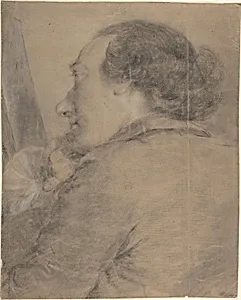
Medium
Black and white chalk on beige paper
Dimensions
15-7/8 x 12-11/16 in. (40.4 x 32.3 cm)
Classification
Drawings
Department
Drawings and Prints
Museum
Metropolitan Museum of Art, New York, NY
Credit
Gift of Richard and Trude Krautheimer, 1979
Accession Number
1979.493
Rights
Public Domain
Tags
Art Historical Context
Thomas Frye's *Portrait of a Man*1760) captures the refined elegance of mid-18th-century British portraiture through a delicate drawing in black and white chalk on beige paper. Measuring15-7/8 x12-11/16, this intimate work Frye's skill as an-Irish artist active in during the Georgian era. primarily for his luminous past and mezzotint enings, Frye often such chalk studies as preparatory or standalone pieces, blendingoco softness with emerging Neoclassical clarity. The beige paper serves as a subtle mid-tone, allowing the white chalk to model highlights on the subject's face and clothing while black chalk deepens shadows for a lifelike three-dimensionality. This technique, popular among 18th-century draftsmen, highlighted texture and expression with economical means—ideal for capturing the poised demeanor of a gentleman amid London's burgeoning portrait boom, fueled by a rising merchant class. Housed in the Metropolitan Museum of Art's Drawings and Prints department (gift of Richard and Trude Krautheimer, 1979), this piece offers a glimpse into Frye's brief but vibrant career, cut short by his death in 1762. It invites visitors to appreciate the artistry of monochrome, where subtle modulation reveals character and era in a single, evocative sheet.
About the Artist
Thomas Frye · 1710–1762
Irish, Edenderry 1710/11–1762 London