
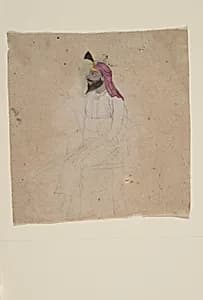
Portrait of a Sikh Noble
Unknown Artist
early 19th century
Medium
Ink, wash, and translucent watercolor on paper
Dimensions
Image (sight): 4 7/8 x 5 in. (12.4 x 12.7 cm) Framed: 16 x 20 in. (40.6 x 50.8 cm)
Classification
Paintings
Culture
India (Punjab Plains)
Department
Asian Art
Museum
Metropolitan Museum of Art, New York, NY
Credit
Gift of Subhash Kapoor, in memory of his parents, Smt Shashi Kanta and Shree Parshotam Ram Kapoor, 2008
Accession Number
2008.359.45
Rights
Public Domain
Tags
Art Historical Context
This delicate *Portrait of a Sikh Noble created by an unknown artist in the 19th century, hails from the Punjab Plains of India and exemplifies the refined tradition of Sikh courtly painting. Rendered in ink, wash, and translucent on paper, the small-scale work (just under 5 inches square) captures the sitter's dignified presence with intricate details—likely including a turban, jewelry, and regal attire that signify his status. Such intimate miniatures were prized in royal ateliers, serving as personal records or album leaves exchanged among elites. Produced during a vibrant era in Punjab's history, when the Sikh Empire under Maharaja Ranjit Singh flourished, this portrait reflects the cultural pride and martial nobility of Sikh society. The use of translucent watercolors allowed for luminous effects, layering subtle tones to convey texture and depth on the modest paper support, a hallmark of regional Pahari-influenced styles adapted by Sikh artists. Now housed in the Metropolitan Museum of Art's Asian Art Department, thanks to a 2008 gift from Subhash Kapoor honoring his parents, this piece invites visitors to appreciate the artistry of everyday heroism in Sikh heritage. Its compact framed display (16 x 20 inches) makes it a gem for close contemplation.