
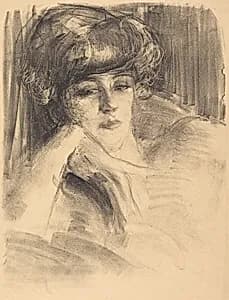
Portrait of a Woman
Medium
crayon lithograph in black on light brown laid paper
Dimensions
sheet: 62 x 46 cm (24 7/16 x 18 1/8 in.)
Classification
Department
CG-W
Museum
National Gallery of Art, Washington, D.C.
Credit
Gift of George and Olga Kenney
Accession Number
1993.72.10
Rights
Public Domain
Art Historical Context
Albert Belleroche's *Portrait of a Woman* (1908) captures the elegance of early 20th-century portraiture through the intimate medium of crayon lithography. Born in 1864 to Anglo-French parents, Beller was a master printmaker whose soft, evocative style drew comparisons to James McNeill Whistler. Working in black crayon on light brown laid paper, this62 x 46 cm sheet exemplifies his ability to achieve painterly depth and subtle tonalities, blending drawing-like spontaneity with the precision of lithography—a process where greasy crayon is applied directly to a stone or plate, then printed to produce rich, velvety textures. Created during the Edwardian era, when lithography flourished as an accessible yet artistic alternative to painting, this work highlights Belleroche's focus on female subjects, rendered with psychological insight and luminous modeling. The light brown paper enhances the monochromatic drama, creating a warm glow that draws viewers into the subject's quiet presence. As a classified print in the National Gallery of Art's collection—generously gifted by George and Olga Kenney—it represents the era's revival of fine art printmaking, bridging 19th-century impressionism with modernist restraint. Today, Belleroche's lithographs remain prized for their technical virtuosity, offering museum visitors a window into a sophisticated world of portraiture where every smudge and line tells a story.