
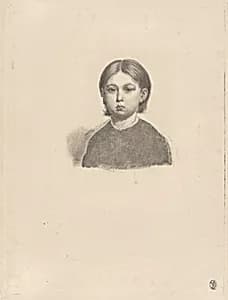
Portrait of a young girl
1832
Medium
Etching
Dimensions
Plate: 10 1/16 × 7 11/16 in. (25.5 × 19.5 cm) Sheet: 13 1/2 in. × 9 in. (34.3 × 22.8 cm)
Classification
Prints
Department
Drawings and Prints
Museum
Metropolitan Museum of Art, New York, NY
Credit
The Elisha Whittelsey Collection, The Elisha Whittelsey Fund, 1949
Accession Number
49.21.157
Rights
Public Domain
Tags
Art Historical Context
In the intimate *Portrait of a Young Girl (1832), Italian etcher Luigi Calamatta captures the tender innocence of youth with masterful precision. Created during the Romantic era, when artists celebrated emotion and individuality, this etching exemplifies Calamatta's reputation as one of Europe's finest reproductive engravers. Though best known for portraits after masters like Ingres, his original works like this one showcase his ability to evoke subtle personality through delicate line work on a copper plate, measuring just 10 1/16 × 7 11/16 inches. Etching, Calamatta's preferred medium, involved drawing acid-resistant lines into a wax ground on metal, then immersing the plate in acid to "bite" the grooves—allowing for rich tonal variations and multiple impressions. This technique democratized fine art, making detailed portraits accessible beyond oil paintings. Housed in the Metropolitan Museum of Art's Drawings and Prints department, part of The Elisha Whittelsey Collection, the print highlights 19th-century fascination with childhood as a symbol of purity amid Europe's social upheavals. Visitors will appreciate how Calamatta's fine, flickering lines suggest the girl's gaze and soft features, blending Neoclassical clarity with Romantic warmth—a timeless tribute to fleeting youth.
About the Artist
Luigi Calamatta · 1801–1869
Comment on works: copper engraver; lithographer