
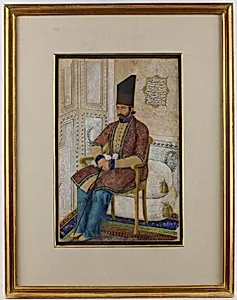
Portrait of `Ali Quli Mirza, I`tizad al-Saltana
dated A.H. 1273/ 1856–57 CE
Medium
Opaque watercolor, gold, and ink on paper
Dimensions
H. 12 5/8 in. (32 cm) W. 8 1/4 in. (21 cm)
Classification
Codices
Department
Islamic Art
Museum
Metropolitan Museum of Art, New York, NY
Credit
Purchase, 2017 and 2018 NoRuz at The Met Benefits, 2019
Accession Number
2019.150
Rights
Public Domain
Tags
Art Historical Context
This striking portrait, created in 1856–57 by the celebrated Persian artist Abu’l Hasan Ghaffari—known as Sani’ al-Mulk—depicts `Ali Quli Mirza, I`tizad al-Saltana, a prominent Qajar prince and statesman. Painted during the reign of Nasir al-Din Shah, the work reflects the refined court culture of nineteenth-century Iran, where royal patronage supported both traditional arts and new forms of representation. As a single-page work on paper rather than part of a larger manuscript, it highlights the growing popularity of independent portraits among the Qajar elite. Sani’ al-Mulk masterfully combines opaque watercolor, gold, and ink to capture the sitter’s dignified presence. Delicate gold detailing on the clothing and background evokes the luxurious aesthetic of Persian manuscript illumination, while the sensitive rendering of the face and posture shows the artist’s skill in blending European-influenced realism with Persian conventions. The compact format—roughly the size of a small book page—suggests it may once have been part of an album or codex. Today in the Metropolitan Museum’s collection of Islamic art, the portrait offers visitors a window into Qajar society and the enduring importance of the painted image as a marker of status and memory.
About the Artist
Abu`l Hasan Ghaffari, known as Sani' al-Mulk · 1814–1866
**Mirza Abu'l-Hasan Khan Ghaffari Kashani (1814–1866), better known as Sani' al-Mulk, was a leading Iranian painter, miniaturist, lacquer artist, and book illustrator of the Qajar era.** Born in Kashan to a family with a long artistic lineage—he was the son of Mīrzā Moḥammad Ḡaffārī and great-nephew of the earlier painter Abu'l-Hasan Mostawfi Ghaffari—he became one of eleven notable painters in hi...