
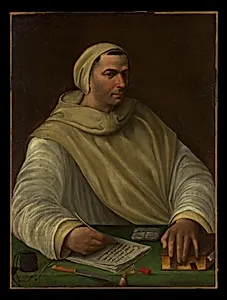
Portrait of an Olivetan Monk
Medium
Oil on canvas
Dimensions
38 1/4 x 28 5/8 in. (97.2 x 72.7 cm)
Classification
Paintings
Department
European Paintings
Museum
Metropolitan Museum of Art, New York, NY
Credit
Gift of Mrs. Charles Wrightsman, 1986
Accession Number
1986.339.1
Rights
Public Domain
Tags
About this artwork
Portrait of an Olivetan Monk is a paintings by Italian artist Baldassare Tommaso Peruzzi, created in 1501–1536. The work was created using oil on canvas. It measures 38 1/4 x 28 5/8 in. (97.2 x 72.7 cm). The painting showcases the artistic techniques and aesthetic sensibilities of its era, reflecting both technical skill and cultural context. Artists of this period developed sophisticated approaches to composition, color, and subject matter that defined their artistic milieu. The work demonstrat...
Art Historical Context
In the serene Portrait of an Olivetan Monk, Italian Renaissance artist Baldassare Tommaso Peruzzi captures the contemplative essence of a monk from the Olivetan order, a Benedictine congregation known for its scholarly devotion. Created sometime between 1501 and1536 during Peruzzi's active years as a Sienese painter and architect, this oil-on-canvas work measures 38¼ × 28⅝ inches (97.2 × 72.7 cm). The half-length portrait likely depicts the figure engaged in writing, a nod to the intellectual pursuits central to monastic life, rendered with the period's refined attention to texture and light. Peruzzi's mastery shines through in his sophisticated use of oil, which allowed for luminous skin tones, intricate folds in the monk's habit, and subtle modeling that brings quiet dignity to the subject. As a product of the High Renaissance transitioning toward Mannerism, the painting reflects evolving techniques in portraiture—emphasizing psychological depth and naturalistic detail amid Italy's vibrant artistic milieu. Such works highlight the era's fascination with individuality, even in religious contexts. Today, this evocative piece graces the Metropolitan Museum of Art's European Paintings department, a gift from Mrs. Charles Wrightsman in 1986. It invites visitors to ponder the intersection of faith, scholarship, and artistry in Renaissance Italy.