
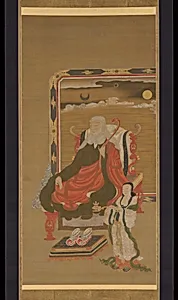
伝教大師(最澄)像|Portrait of Dengyō Daishi (Saichō)
early 18th century
Medium
Hanging scroll; ink, color, and gold on silk
Dimensions
Image: 46 1/8 × 22 7/8 in. (117.2 × 58.1 cm) Overall with mounting: 76 1/2 × 28 3/8 in. (194.3 × 72.1 cm) Overall with knobs: 76 1/2 × 31 in. (194.3 × 78.7 cm)
Classification
Paintings
Culture & Period
Japan · Edo period (1615–1868)
Department
Asian Art
Museum
Metropolitan Museum of Art, New York, NY
Credit
Mary and Cheney Cowles Collection, Gift of Mary and Cheney Cowles, 2020
Accession Number
2020.396.6
Rights
Public Domain
Art Historical Context
This exquisite hanging scroll portrays Dengyō Daishi, the posthumous title of Saichō (767–822), the revered Japanese Buddhist monk who founded the Tendai school. In the early 18th century, during Japan's Edo period (1615–1868), such portraits were created by unidentified artists to honor spiritual leaders, often displayed in temples or homes for meditation and devotion. Saichō's legacy endures through his establishment of Enryaku-ji temple on Mount Hiei near Kyoto, where he blended esoteric Chinese Buddhism with native Shinto elements, shaping Japanese religious life for centuries. Crafted in ink, color, and gold on silk—a luxurious medium reserved for significant works—the painting exemplifies Edo-era finesse in portraiture. The large format (nearly 77 inches tall with mounting) allowed it to command space when unrolled, with gold accents evoking divine radiance and silk providing a shimmering backdrop. These scrolls were not mere decorations but ritual objects, fostering a connection to the divine amid the period's cultural flourishing under the Tokugawa shogunate. On view in the Metropolitan Museum of Art's Asian Art department, this portrait from the Mary and Cheney Cowles Collection invites visitors to reflect on Japan's enduring Buddhist traditions and the artistry that immortalized its saints.
About the Artist
Unidentified ( ) · –