
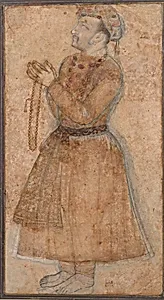
Portrait of Emperor Jahangir Praying
Unknown Artist
early 17th century
Medium
Ink and opaque watercolor on paper
Dimensions
Page: H. 11 in. (27.9 cm) W. 6 5/16 in. (16 cm) Mat: H. 19 1/4 in. (48.9 cm) W. 14 1/4 in. (36.2 cm) Frame: H. 21 3/4 in. (54.6 cm) W. 16 3/4 in. (42.5 cm)
Classification
Codices
Department
Islamic Art
Museum
Metropolitan Museum of Art, New York, NY
Credit
H. O. Havemeyer Collection, Gift of Horace Havemeyer, 1929
Accession Number
29.160.19
Rights
Public Domain
Tags
Art Historical Context
This delicate portrait captures Emperor Jahangir, fourth Mughal ruler of Indiar. 1605–1627), in a profile view as he prays, rendered in ink and opaque watercolor on paper an unknown artist in the 17th century. about 11 by 6 inches, it hails from the refined tradition of Mughal miniature painting, often featured in codices—manuscripts or album pages prized for their portability and intimacy. Jahangir's reign marked a pinnacle of Mughal artistic patronage, blending Persian stylistic elegance with heightened realism and psychological depth in portraiture. The opaque watercolor technique, layering vibrant pigments over ink outlines, creates luminous skin tones and intricate details in the emperor's turban and robes, emphasizing his piety. Such devotional images underscored the Mughal ideal of a just ruler divinely guided, bridging imperial power and Islamic spirituality. Now in the Metropolitan Museum of Art's Islamic Art department, from the H.O. Havemeyer Collection, this work invites visitors to ponder the human side of empire amid the courtly splendor of 17th-century South Asia.