
Portrait of Five Children
c. 1850
Medium
daguerreotype
Dimensions
image (visible): 9 × 12 cm (3 9/16 × 4 3/4 in.) mat: 10.8 × 13.7 cm (4 1/4 × 5 3/8 in.) case (closed): 15.2 × 12 × 2.3 cm (6 × 4 3/4 × 7/8 in.)
Classification
Photograph
Department
CPH
Museum
National Gallery of Art, Washington, D.C.
Credit
Clinton and Jean Wright Fund
Accession Number
2015.95.1
Rights
Public Domain
Art Historical Context
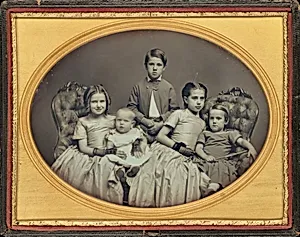
Step back to mid-19th-century America with *Portrait of Five Children*, poignant daguerreotype from around 1850. This intimate photograph captures the solemn gazes of five young siblings, likely posed in a studio setting typical of the era. Created by an anonymous American photographer, it exemplifies the daguerreotype process—invented in 1839 by Louis Daguerre—which involved exposing a polished silver-plated copper sheet to mercury vapor and light, producing a one-of-a-kind mirror-like positive image. At just 9 × 12 cm, the visible image fits neatly into its protective case, a common feature to shield these delicate treasures from scratches and tarnish. Daguerreotypes revolutionized portraiture, making professional likenesses affordable for middle-class families who could not commission painted portraits. By 1850, this medium dominated American photography studios, preserving everyday moments like family gatherings amid rapid social changes, including westward expansion and industrialization. The children's formal attire and composed expressions reflect Victorian ideals of childhood innocence and decorum. Housed in the National Gallery of Art's photography collection, thanks to the Clinton and Jean Wright Fund, this small yet evocative piece highlights photography's role in democratizing memory. Its survival underscores the fragility and allure of early photos—no negatives meant each was unique, a singular glimpse into lives long past.
About the Artist
American 19th Century · 1800–1900
The artist cataloged as "American, 19th Century" represents a collective of unidentified painters active in the United States during the nineteenth century, with 380 known artworks preserved in this virtual museum's collection. These works span a diverse array of genres typical of the era, including portraits, landscapes, still lifes, and genre scenes, reflecting the burgeoning artistic output of ...