
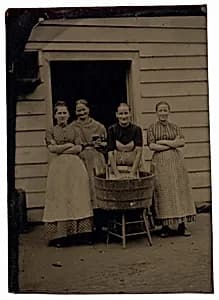
Portrait of Four Washwomen
c. 1870s
Medium
tintype
Dimensions
image/plate: 8.8 × 6.2 cm (3 7/16 × 2 7/16 in.)
Classification
Photograph
Department
CPH
Museum
National Gallery of Art, Washington, D.C.
Credit
The Ross J. Kelbaugh Collection
Accession Number
2023.146.61
Rights
Public Domain
Art Historical Context
This intimate tintype portrait captures four washwomen from 1870s America, a rare glimpse into the daily lives of working-class women the post-Civil War era. Produced by an anonymous American photographer, the small image (just 3 7/16 × 2 7/16 inches) likely served as a cherished personal memento, highlighting the dignity of laborers often overlooked in formal art. Tintypes, invented in the 1850s, were a revolutionary photographic medium: a collodion emulsion on a thin iron plate created a unique, direct positive image without negatives. Affordable and durable, they were ideal for itinerant photographers serving everyday folk, from farmers to factory workers. This format democratized portraiture, preserving moments of camaraderie among women whose grueling washwork sustained urban households. Housed in the National Gallery of Art's CPH department from The Ross J. Kelbaugh Collection, the portrait underscores photography's role in documenting social history. It invites us to ponder these women's stories—resilient figures in aprons, gazing steadily at the camera amid America's industrial boom.
About the Artist
American 19th Century · 1800–1900
The artist cataloged as "American, 19th Century" represents a collective of unidentified painters active in the United States during the nineteenth century, with 380 known artworks preserved in this virtual museum's collection. These works span a diverse array of genres typical of the era, including portraits, landscapes, still lifes, and genre scenes, reflecting the burgeoning artistic output of ...