
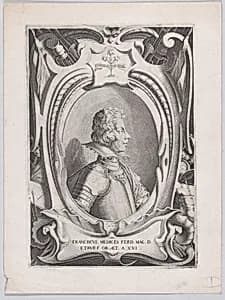
Portrait of Francesco de' Medici
Medium
Engraving
Dimensions
Sheet: 10 1/16 x 7 9/16 in. (25.6 x 19.2 cm) Plate: 8 1/2 x 5 7/8 in. (21.6 x 15 cm)
Classification
Prints
Department
Drawings and Prints
Museum
Metropolitan Museum of Art, New York, NY
Credit
Gift of Albert Ten Eyck Gardner, 1950
Accession Number
50.587.27
Rights
Public Domain
Art Historical Context
This exquisite engraving, *Portrait of Francesco de'*, captures the likeness of Francesco I de' Medici, Duke of Tuscany (1541–1587), rendered by the masterful French printmaker Jacques Callot in 1614. Though created over two decades after the duke's death, it reflects the enduring prestige of the Medici family, Tuscany powerful Renaissance dynasty renowned for patronage of the arts science, and architecture. Francesco himself ruled from 1574 to 1587, grand projects like the Uffizi Gallery while navigating political intrigue in a turbulent Europe. Callot, a Baroque-era virtuoso active at the Medici court in Florence, excels here in the intricate technique of engraving. Using a burin to incise fine lines into a copper plate—measuring just 8½ x 5⅞ inches—he achieves remarkable detail and tonal depth, from the duke's ornate armor and ruffled collar to his stern gaze. This small-scale print (sheet 10⅛ x 7⁹⁄₁₆ inches) exemplifies 17th-century reproductive printmaking, allowing wide dissemination of elite portraits to affirm status and legacy. Housed in the Metropolitan Museum of Art's Drawings and Prints department (gift of Albert Ten Eyck Gardner, 1950), this work highlights engraving's role in preserving nobility amid shifting dynasties, inviting us to ponder the Medici's lasting cultural imprint.
About the Artist
Jacques Callot|Francesco de' Medici, Grand Duke of Tuscany · 1592–1635
Jacques Callot (1592–1635) was a French printmaker and draftsman from the Duchy of Lorraine, widely regarded as one of the first great artists to practice the graphic arts exclusively. His more than 1,400 etchings chronicled the breadth of 17th-century life, from Medici court festivities to the brutal realities of warfare. Callot revolutionized etching through technical innovations including the é...