
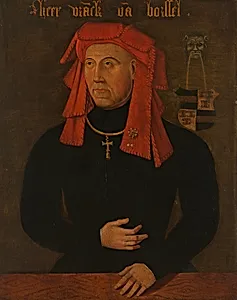
Portrait of Frank van Borselen, Lord of Sint Maartensdijk and Stadtholder of Holland, fourth Husband of Jacoba of Bavaria, Countess of Holland and Zeeland (Jacqueline, Countess of Hainaut)
after c. 1480
Medium
oil on panel
Dimensions
h 64cm × w 50cm
Classification
painting
Museum
Rijksmuseum, Amsterdam
Rights
Public Domain
About this artwork
Portret van Frank van Borselen (overl. 1470). Vierde echtgenoot van Jacoba van Beieren. Stadhouder van Zeeland. Ten halven lijve, staande achter een houten blad, iets naar links. Om de hals een ketting met het kruis van de Orde van St. Antonius. Rechtboven het familiewapen. Zestiende-eeuwse kopie naar het origineel uit ca. 1435. Pendant van SK-A-498.
Art Historical Context
This evocative portrait captures Frank van Borselen (. 1470), a prominent 15th-century nobleman who served as Lord of Sint Maartensijk and Stadtholder Zeeland. He was the fourth husband Jacoba of Bavaria (Jacqueline, Countess ofainault, Holland, and Zeeland a resilient countess whose turbulent life shaped medieval Low Countries politics amid dynastic struggles and wars of succession. Painted as a half-length figure standing slightly turned to the left behind a wooden parapet, van Borselen exudes authority, his neck adorned with the cross of the Order of St. Antonius—a prestigious knightly order—and his family coat of arms displayed prominently above. Though created by an anonymous artist after c. 1480 in oil on panel (64 × 50 cm), this work is a 16th-century copy of an original dating to around 1435, preserving early Northern Renaissance portraiture traditions. Oil on panel allowed for rich detail and luminosity, ideal for conveying status through realistic attire and symbolic accessories, reflecting the era's growing emphasis on individualized likenesses among the elite. Housed at the Rijksmuseum as part of a pendant pair (with Jacoba's portrait, SK-A-498), it offers a window into 15th-century nobility, highlighting marital alliances and chivalric pride that defined European feudal society. A testament to enduring historical memory, this copy bridges centuries, inviting us to ponder the personal stories behind political power.
About the Artist
anonymous
In the vast tapestry of art history, "Anonymous" stands not as a singular individual but as a collective designation for countless unidentified creators whose works have endured across millennia. These artists, spanning prehistoric cave painters to medieval illuminators and folk craftsmen, produced the foundational layers of human visual culture. Prior to the Renaissance, when individual fame emer...