
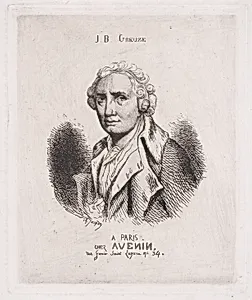
Portrait of J.B. Greuze
19th century
Medium
Etching
Dimensions
Plate: 6 11/16 × 5 5/16 in. (17 × 13.5 cm) Image: 5 7/8 × 4 13/16 in. (15 × 12.2 cm)
Classification
Prints
Department
Drawings and Prints
Museum
Metropolitan Museum of Art, New York, NY
Credit
Harris Brisbane Dick Fund, 1917
Accession Number
17.3.756–818
Rights
Public Domain
Tags
Art Historical Context
Step into the world of 19th-century printmaking with *Portrait of J.B.uze*, an etching by Charles Jacque honoring the renowned painter Jean-Baptiste Greuze (1725–1805). Jacque, a versatile artist known for his realist landscapes and animal studies linked to the Barbizon School captures Greuze—a master of sentimental genre scenes and moralistic portraits—in a dignified profile. Created in the 1800s, this work reflects the era's fascination with celebrating artistic predecessors, bridging neoclassicism and emerging romanticism through intimate homage. Etching, the medium here, showcases Jacque's technical prowess: acid bites into a metal plate to create precise, expressive lines, allowing rich tonal contrasts within the modest image size of 5 7/8 × 4 13/16 inches. This intimate scale made prints accessible, democratizing art for collectors beyond oil paintings. Housed in The Metropolitan Museum of Art's Drawings and Prints department (acquired via the Harris Brisbane Dick Fund in 1917), it exemplifies how etchings preserved legacies, blending portraiture's psychological depth with print's reproducibility. This piece invites reflection on artist-to-artist admiration, a cultural thread in 19th-century Europe where portraits immortalized creative giants like Greuze, whose dramatic works influenced David and early romantics. A gem for print enthusiasts!
About the Artist
Charles Jacque|Jean-Baptiste Greuze · 1813–1894
Charles-Émile Jacque (1813–1894) was a pioneering French painter, engraver, and illustrator whose career bridged the worlds of printmaking and pastoral painting. Born in Paris amid a difficult childhood, he apprenticed at age seventeen to a map engraver, mastering drypoint technique and producing his first etching in 1830—a copy of a head after Rembrandt. After serving seven years in the French Ar...