
Portrait of Jan van Leiden, a Dutchman and leader of the Münster Anabaptists
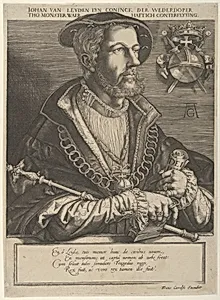
Medium
Engraving; New Hollstein’s fourth state of five
Dimensions
Sheet: 12 1/2 × 9 3/16 in. (31.8 × 23.4 cm)
Classification
Prints
Department
Drawings and Prints
Museum
Metropolitan Museum of Art, New York, NY
Credit
Harris Brisbane Dick Fund, 1917
Accession Number
17.3.910
Rights
Public Domain
Tags
Art Historical Context
This striking engraving, *Portrait of Jan van Leiden a Dutchman and leader the Münster Anabists*, captures the infamous 16th-century radical preacher Jan Beuckelszoon (also known as John of Leiden Dated around 1615 and attributed to engravers Heinrich Aldegrever, Jan Muller, or Frans Carese, it represents the fourth state of five in New Hollstein’s catalog—a testament to the print’s enduring popularity through multiple editions. Measuring 12½ × 9⅛ inches, the sheet features a detailed portrait with a prominent coat of arms, highlighting the subject’s self-proclaimed royal status during the tumultuous Münster Rebellion of 1534–35. Jan van Leiden rose to notoriety as a leader of the Anabaptist movement, a radical Protestant sect advocating adult baptism and communal living. In Münster, he declared himself king of a prophesied "New Jerusalem," instituting polygamy and other controversial practices amid a bloody siege by Catholic and Protestant forces. Captured and executed in 1536, his image persisted in later prints like this one, serving as both historical record and cautionary tale against religious extremism in Europe’s Reformation era. As an engraving from the Dutch Golden Age’s printmaking tradition, the work showcases meticulous line work and tonal depth, allowing widespread dissemination of portraits and heraldry. Housed in the Metropolitan Museum of Art’s Drawings and Prints department (Harris Brisbane Dick Fund, 1917), it invites reflection on how art immortalizes complex historical figures, blending portraiture with propaganda.
About the Artist
Heinrich Aldegrever|Jan Muller|Frans Carelse · 1502–1561
Heinrich Aldegrever, born in 1502 in Paderborn, Westphalia, to parents Herman and Katherine Trippenmeker—a family of clog-makers known by the dialect name Trippenmecker—emerged as a multifaceted artist in the German Renaissance. His early training remains undocumented, though he likely apprenticed in a Soest goldsmith's workshop after relocating there around 1525, where he joined the painters' gui...