
Portrait of Johann Friedrich the Magnanimous, Elector of Saxony
1543
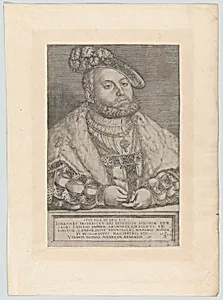
Medium
Engraving
Dimensions
Sheet (trimmed; without frame): 13 1/16 × 8 7/16 in. (33.2 × 21.4 cm)
Classification
Prints
Department
Drawings and Prints
Museum
Metropolitan Museum of Art, New York, NY
Credit
Rogers Fund, 1921
Accession Number
21.29.1
Rights
Public Domain
Tags
Art Historical Context
Behold the striking *Portrait of Johann Friedrich the Magnanimous, Elector Saxony* (1543), an engraving by Georg Pencz, a master of the German Renaissance known among the "Little Masters" his intricate small-scale prints. Pencz, active in Nuremberg, drew inspiration from Albrecht Dürer, crafting detailed images that captured the era's humanist ideals and Reformation fervor. This work, measuring about 13 × 8 inches, exemplifies his skill in rendering a dignified profile of the elector, emphasizing his noble bearing through precise line work. Johann Friedrich, a pivotal Protestant leader and defender of Martin Luther, earned his epithet "the Magnanimous" for his steadfast support of the Schmalkaldic League against Emperor Charles V. Created in 1543 amid rising religious tensions, this portrait served as both a personal likeness and political emblem, disseminating the elector's image through the reproducible medium of engraving—a revolutionary technique for the time that allowed widespread dissemination of authority and identity. Housed in the Metropolitan Museum of Art's Drawings and Prints department (Rogers Fund, 1921), this trimmed sheet highlights engraving's enduring appeal: its fine burin lines create depth and texture on paper, making elite portraiture accessible. A window into 16th-century Saxony, it invites us to ponder the power of print in shaping history.
About the Artist
Georg Pencz · 1490–1550
Comment on works: Religious; History; Portraits