
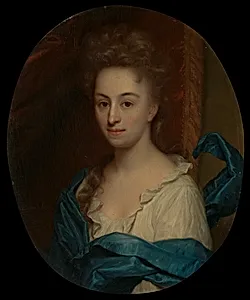
Portrait of Josina Clara van Citters (1671-1753)
1699 - 1706
Medium
oil on canvas
Dimensions
h 30cm × w 25cm × d 5.5cm
Classification
painting
Museum
Rijksmuseum, Amsterdam
Rights
Public Domain
About this artwork
Portret van Josina Clara van Citters (1671-1753), dochter van Josina Parduyn. Buste, naar links, in ovaal.
Art Historical Context
In the hallowed halls of the Rijksmuseum Godfried Schalcken'sPortrait of Josina Clara Citters (1671-1753)* the refined elegance of Dutch Golden Age portraiture. Painted between 1699 and 1706, this intimate oil-on-canvas work depicts Josina Clara, daughter of Josina Pardu, as a bust-length figure turned slightly to the left within an oval frame. At roughly 30 x 25 cm, its compact scale suggests it was a personal cabinet piece, cherished in a private home rather than a grand public display. Schalcken, a master of tenebrism influenced by Rembrandt and Gerrit Dou, excelled in dramatic light effects, often using candlelight to sculpt forms from shadow. Though this portrait favors a more subdued illumination, his signature chiaroscuro likely accentuates Josina's poised features, conveying quiet dignity. Created late in the artist's career (he died in 1706), it reflects the era's prosperity, where patrician families like the van Citters commissioned such likenesses to affirm status and lineage. This gem offers a window into 18th-century Dutch society, blending technical virtuosity with personal narrative—Josina lived to 82, outlasting the painting's creation by decades. A testament to Schalcken's enduring skill, it invites visitors to ponder the lives behind the canvas.
About the Artist
Godfried Schalcken · 1643–1706
Studied with Samuel van Hoogstraten in Dordrecht in 1656 and Gerrit Dou in Leiden. He returned to Dordrecht in 1665, where he was a standard-bearer with the arquebusiers. In 1679 he married Françoise van Dimen, of Breda, with whom he had seven children, six of whom died young. He was a guild member in The Hague in 1691, before leaving to spend several years in London, attracted by the success of h...