
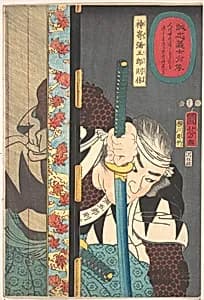
Portrait of Kansake Yagoro Noriyasu
Medium
Woodblock print; ink and color on paper
Dimensions
H. 14 5/8 in. (37.1 cm); W. 9 7/8 in. (25.1 cm)
Classification
Prints
Culture & Period
Japan · Edo period (1615–1868)
Department
Asian Art
Museum
Metropolitan Museum of Art, New York, NY
Credit
Fletcher Fund, 1929
Accession Number
JP1551
Rights
Public Domain
Tags
Art Historical Context
### Portrait of Kansake Yagoro Noriyasu striking woodblock print from 1852, created by Utagawa Kunoshi in collaboration with Yokogawaitake, captures the fierce intensity of Kansake Yag Noriyasu, a likely drawn from Japanese warrior lore. Measuring 14⅝ × 9⅞ inches, the work exemplifies the vibrant *nishiki-e* (brocade print) technique of the Edo period (1615–1868), where intricate woodblocks were carved separately for each color, layered with ink and pigments on paper to produce rich, multicolored images affordable to the masses. Kuniyoshi, a master of the ukiyo-e school, was renowned for his dynamic *musha-e* (warrior prints) that celebrated samurai valor amid Japan's feudal era. Here, the portrait's bold lines and dramatic shading highlight Noriyasu's stern gaze and weaponry—evident in the tags for swords and male portraits—evoking the chivalric ideals of bushido. Produced during a time when woodblock prints flourished as popular art, this piece reflects Edo Japan's fascination with heroic tales, blending historical reverence with theatrical flair. Housed in the Metropolitan Museum of Art's Asian Art department (Fletcher Fund, 1929), it offers visitors a window into 19th-century Japan's cultural pulse, where art immortalized legends for everyday appreciation.
About the Artist
Yokogawa Horitake|Utagawa Kuniyoshi ( |Japanese) · |1797 – |1861
|Japanese, 1797–1861