
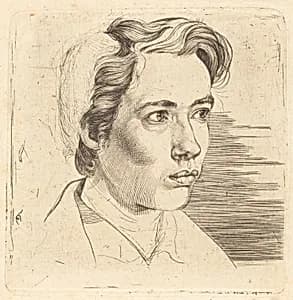
Portrait of Maisonneuve
Medium
engraving with etching on laid paper
Dimensions
plate: 7.5 x 7.2 cm (2 15/16 x 2 13/16 in.) sheet: 19.8 x 16.8 cm (7 13/16 x 6 5/8 in.)
Classification
Department
CG-E
Museum
National Gallery of Art, Washington, D.C.
Credit
Ailsa Mellon Bruce Fund
Accession Number
1999.141.2
Rights
Public Domain
Art Historical Context
Welcome to the National Gallery of, where we spotlight *Portrait of Maisonneuve* (1824), a delicate engraving with etching by Eugen Eduard Schae. This intimate print captures the likeness of Paul de Chomedey deonneuve, the 17th-century French military officer and founder of Montreal, Canada. Created two centuries after his death, Schaeffer's work reflects early 19th-century interest historical figures who shaped colonial North America, blending reverence with portraiture traditions. The artwork's small plate size—7.5 x 7.2 cm—suggests it was designed for close viewing, perhaps in books or collections, on laid paper that shows the subtle texture of its wire mesh during production. Engraving provided precise, controlled lines for facial details and clothing folds, while etching added softer, atmospheric tones through acid biting. This hybrid technique, popular in the Romantic era, allowed Schaeffer to achieve both sharpness and depth in a compact format. Acquired through the Ailsa Mellon Bruce Fund, this print exemplifies printmaking's role in preserving cultural heroes. Maisonneuve's stern gaze evokes his legacy as a pioneer, inviting visitors to ponder the enduring impact of exploration and settlement on modern identities. A gem for history and technique enthusiasts alike!