
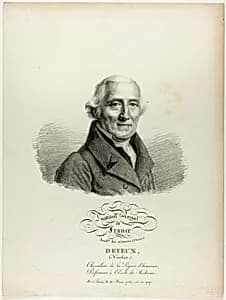
Portrait of Nicolas Deyeux
1822
Medium
Lithograph in black on ivory wove paper
Dimensions
Image: 13.7 × 17.4 cm (5 7/16 × 6 7/8 in.); Sheet: 32.8 × 24.7 cm (12 15/16 × 9 3/4 in.)
Classification
lithograph
Department
Prints and Drawings
Museum
Art Institute of Chicago
Accession Number
41073
Rights
Public Domain
Art Historical Context
**Portrait of Nicolas Deyeux by Jules Boilly, in 1822, the elegance of early 19th French portraiture. Jules Boilly, son of the renowned painter Louis-Léopold Bo, was a skilled draftsman who embraced emerging printmaking techniques. This intimate likeness, housed in the Art Institute of Chicago's Prints and Drawings, reflects the post-Napoleonic era's fascination with personal commemoration amid France's Restoration period, when individual identities were increasingly documented through accessible media. Printed as a lithograph in black ink on ivory wove paper (image: 13.7 × 17.4 cm; sheet: 32.8 × 24.7 cm), the work exemplifies lithography's revolutionary potential just two decades after its invention. This technique allowed artists like Boilly to draw directly on limestone with greasy crayon, producing rich, tonal effects that mimicked pencil sketches while enabling multiple impressions. It democratized high-quality portraits, making them affordable beyond elite oil paintings. As a fine example of early lithography, this piece highlights the medium's artistic significance in bridging drawing and printmaking, preserving delicate details of expression and attire for posterity. Visitors will appreciate its technical precision and the window it offers into 1820s cultural life.