
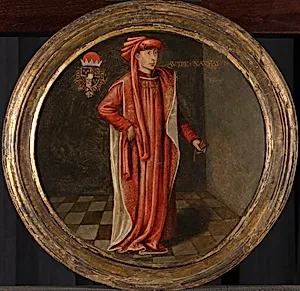
Portrait of Philip the Good, Duke of Burgundy
c. 1460 - c. 1480
Medium
oil on panel
Dimensions
d 38.7cm × t 3.3cm
Classification
painting
Museum
Rijksmuseum, Amsterdam
Rights
Public Domain
About this artwork
Portret van Filips de Goede, hertog van Bourgondië. Staande, naar links, ten voeten uit op een tegelvloer. Om de hals de keten van het Gulden Vlies. Rechtsboven het familiewapen. Met geïntegreerde lijst. Pendant van SK-A-3836.
Art Historical Context
This striking *Portrait of Philip the Good, Duke Burgundy* (c. 1460–1480) captures the powerful ruler standing full-length on a tiled floor, turned slightly to the left. Rendered anonymously in oil on a round panel (tondo) measuring 38.7 in diameter, the work features Philip adorned with the prestigious chain of the Order of the Golden Flee around his neck—a symbol of chivalric elite he founded in 1430. The family coat of arms appears top right, and the painting includes an integrated frame, enhancing its jewel-like quality. Philip the Good (1396–1467) ruled Burgundy during its golden age, transforming it into a cultural and political powerhouse in the Low Countries through strategic marriages and patronage of the arts. Likely a posthumous portrait given the date, it reflects the era's fascination with realistic, full-figure depictions of nobility, bridging medieval and Renaissance ideals. As a pendant to another Rijksmuseum work (SK-A-3836), it may have formed a dynastic pair, common in Burgundian courts. Crafted in the Early Netherlandish style, the oil-on-panel medium allowed for luminous detail and subtle modeling, hallmarks of artists like Rogier van der Weyden. Housed at the Rijksmuseum, this anonymous gem offers a window into 15th-century courtly splendor and the dawn of portraiture's evolution.
About the Artist
anonymous
In the vast tapestry of art history, "Anonymous" stands not as a singular individual but as a collective designation for countless unidentified creators whose works have endured across millennia. These artists, spanning prehistoric cave painters to medieval illuminators and folk craftsmen, produced the foundational layers of human visual culture. Prior to the Renaissance, when individual fame emer...